
When Investors Ask About Market Size, You Need Three Numbers
Tell an investor "the market is worth 100 trillion won" — roughly $73 billion — and the follow-up question is always the same: "So how much of that can you actually capture?"
The fact that a $73 billion market exists is one thing. Whether your business can actually make money in it is another matter entirely. TAM, SAM, and SOM are the framework that makes that gap visible.
Founders, product managers, and business planners are all expected to know this cold, yet the three terms get mixed up constantly. Here's a plain-language breakdown.
Think of It as Fishing, and It Clicks Instantly
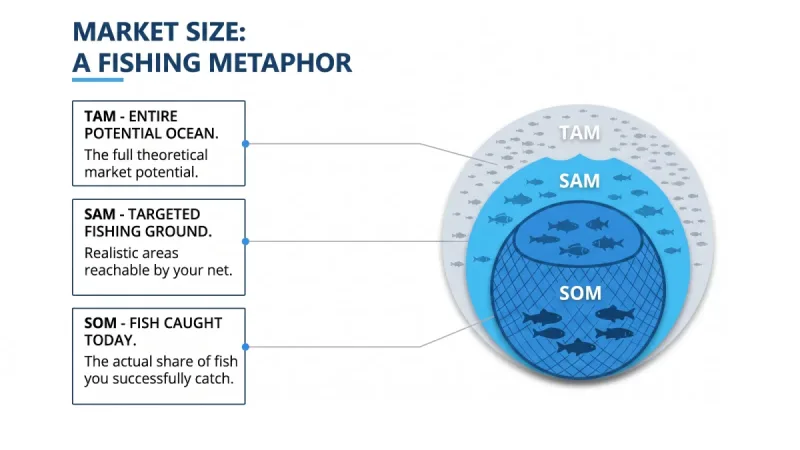
Picture the ocean, and ask how many fish are actually in it.
TAM is every fish in the entire ocean. How many tuna exist in the whole Pacific — regardless of whether anyone could ever catch them. It's the theoretical size of the total market: the full scale of demand out there, whether or not you can reach a single dollar of it.
SAM is the fish your boat can actually reach. Not the whole Pacific — only the waters within your boat's range, and only the species your nets are built to catch. It's the slice of the market your product can realistically serve.
SOM is the fish you'll actually haul in today. Given your boat's size, your crew, your fuel, and how many other boats are competing for the same catch, this is what you can realistically bring home. It's the revenue your current capabilities can actually capture.
Defining the Three, Precisely
TAM (Total Addressable Market) — the total market
This is the total market size if every potential customer who has the problem your product solves bought your product — with no limits from geography, competition, or your own capacity. It's the theoretical ceiling.
If you're building an online English-education service, for instance, your TAM is everyone on Earth who wants to learn English — potentially billions of people. That's not remotely realistic, but it tells you where the ceiling sits.
TAM matters because if this number is too small, no amount of execution will turn the business into something meaningful. Investors look at TAM to answer one question: is this market big enough to be worth backing?
SAM (Serviceable Addressable Market) — the market you can serve
This is the slice of TAM your product can actually reach, filtered by geography, language, price point, distribution channels, and the specifics of what you've built.
Take that same online English-education service: if it only operates in Korean and only supports Korean payment systems, the SAM narrows to "adults in Korea who want to learn English online" — a fraction of the TAM.
SAM is the actual stage your business competes on. It answers: how big is the market where my product can realistically compete?
SOM (Serviceable Obtainable Market) — the market you can capture
This is the portion of SAM you can realistically capture in the short term — typically one to three years — reflecting your actual marketing budget, sales headcount, brand awareness, and competitive landscape.
Even if Korea's online English-education market (the SAM) is worth 500 billion won — about $365 million — capturing 2% of it in your first year puts your SOM at 10 billion won, or roughly $7.3 million. That number becomes the actual revenue target in your business plan.
SOM is the most grounded of the three numbers, and investors scrutinize its logic more closely than anything else. You need a convincing answer to one question: why do you believe you can win that 2%?
Working Through a Real Example
Say you're launching a subscription service for premium pet health food.
TAM. The global pet food market — roughly 150 trillion won, or about $110 billion, covering everything from kibble and treats to health food and supplements. You're never going to own this entire market, but it confirms the opportunity is plenty big.
SAM. Korea's premium dog health food market. Narrow the global figure down to the health-food category, then to dogs specifically, then to the premium price tier, and you land at an estimated 300 billion won, or about $220 million.
SOM. Customers you can actually sign up in year one — small-dog owners in Seoul and Gyeonggi Province, on a monthly subscription model. Given a realistic marketing budget and logistics capacity, that's about 5,000 monthly subscribers, or roughly 3 billion won — about $2.2 million — in annual revenue. That's the realistic first-year target.
Same business, but the number narrows from 150 trillion won to 300 billion to 3 billion. You need to show all three together to convey both the size of the opportunity and the realism of the plan.
Three Mistakes Founders Keep Making
First, inflating TAM and stopping there. "The AI market is worth 1,000 trillion won" — about $730 billion — sounds impressive, but it means nothing if you can't follow up with your product's SAM and SOM. Investors care less about the size of TAM than about the logic connecting TAM down to SOM.
Second, confusing SAM with SOM. "Korea's market is worth 500 billion won, so our revenue target is 500 billion won" doesn't hold up. SAM is the entire addressable market, competitors included; SOM is the share you can actually take from it. No business plan gets to assume 100% market share.
Third, playing SOM too safe. Go too conservative, on the other hand, and you can't make the case for why anyone should invest at all. SOM needs to be realistic but ambitious. What matters isn't the size of the number — it's pairing that number with a concrete path (channels, strategy, resources) for actually getting there.
Two Ways to Run the Numbers
Top-Down
Start with big market data and narrow it down. Pull the total market size (TAM) from an industry report, filter by region, category, and price tier to get SAM, then multiply by expected market share to arrive at SOM.
The upside: it's fast and paints the big picture well. The downside: the numbers stay abstract, so they wobble under the question "okay, but what's your evidence?"
Bottom-Up
Start small and build up. Annual spend per customer, multiplied by the number of customers you can realistically acquire, equals SOM. From there, you work backward to SAM and TAM based on what share of the total market that SOM represents.
The upside: every number has concrete grounding. The downside: you can lose sight of the market's big picture.
In practice, you do both. Top-down shows the size of the opportunity; bottom-up proves the execution plan is realistic. If the two approaches produce wildly different numbers, an assumption somewhere is wrong.
How to Present This in a Business Plan
When presenting to investors, this order tends to flow naturally.
Start with TAM to establish the size of the opportunity: "This market is plenty big." Then narrow the focus with SAM: "Within it, this is the range we're actually competing in." Finally, lay out the execution plan with SOM: "Here's how much we'll capture in year one, and how."
Then show the expansion path — from SOM toward SAM, and from SAM toward TAM: "Starting in Seoul, then nationwide; starting in Korea, then across Asia." That expansion path becomes the growth story of the business.
If you need it in one sentence: TAM is the size of the dream, SAM is the stage you can actually fight on, and SOM is tomorrow's revenue. Show all three together, and you convey both the possibility and the realism of the business at once.