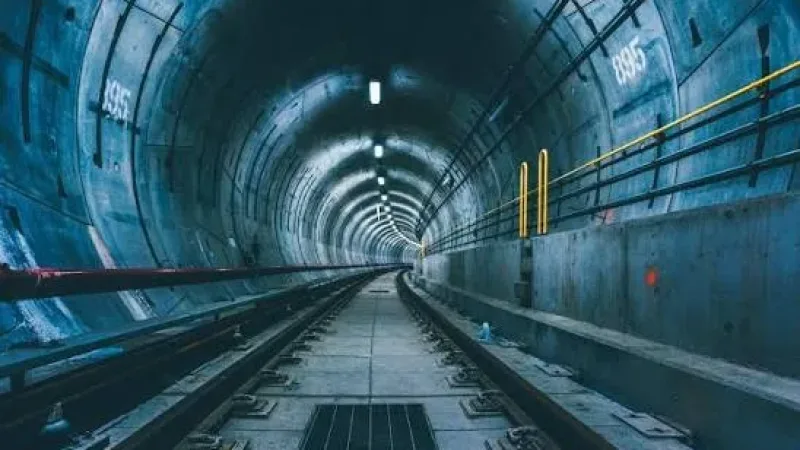

Hyundai Engineering & Construction and Samsung C&T have had a contract cancelled at the client's request — the deal, won in 2022, to build a tunnel at Saudi Arabia's NEOM. The roughly $1 billion (about 1.3 trillion won) project called for a 12.5-kilometer tunnel beneath "The Line" that would carry a highway, a subway, and a freight railway together. Hyundai E&C announced that the cancellation "stems from a restructuring of the client's business" and that there would be "no financial loss," but the episode lays bare the structural fragility of Saudi Arabia's megaprojects.
Between Vision 2030's Dazzling Blueprint and Reality
NEOM is the emblematic project of Saudi Vision 2030. The idea is to build a smart city across 26,000 square kilometers on the Red Sea coast and, in doing so, diversify an economy dependent on oil. "The Line" in particular — a linear city 170 kilometers long and 500 meters high — has been presented as a model for a city of the future, home to a million residents.
But this halted tunnel work illustrates the volatility specific to megaprojects. Behind the official reason of "business restructuring," a tangle of factors was almost certainly at play: financing problems, technical difficulty, shifting political priorities. The reality of Saudi Arabia's business environment is that even a $1 billion project can be stopped overnight.
The Structural Dilemma Facing Korean Companies
For Korean construction firms, Saudi Arabia is one of the largest export markets. As of 2023, contracts won in the Middle East totaled $28.5 billion — 60 percent of all overseas construction awards. Megaprojects like NEOM, the Riyadh new town, and Qiddiya are attractive in scale and profitability, yet they carry unpredictable risk in equal measure.
The trouble is that this risk is not simple market fluctuation. Saudi megaprojects are tied directly to the national strategy of economic diversification, but they are also shaped by political spectacle and the power structure of the royal family. As with the anti-corruption crackdown that played out at the Ritz-Carlton hotel in 2017, a sudden policy shift or reshuffling of power can fundamentally alter the business landscape.
Hyundai E&C says there will be "no financial loss," but this only means the accounting for costs already incurred has been settled. Opportunity cost and strategic loss are another matter entirely. Halting a project that took four years to prepare and carry out is tantamount to losing the chance to deploy that workforce and those resources elsewhere.
The Political Economy of Megaprojects
The cancelled NEOM tunnel reveals the essential character of Saudi megaprojects. Such ventures are driven less by pure economic logic than by political symbolism and the goal of national branding. They are a way to showcase Crown Prince Mohammed bin Salman's (MBS) appetite for reform and to sell a "new Saudi Arabia" to international investors.
But that same character is poison to a project's longevity. The moment political priorities change or budget pressure intensifies, the scope can be cut or the work stopped. NEOM's own initial plans were in fact revised downward several times, from $500 billion toward more realistic figures.
What Korean companies need to understand is that Saudi megaprojects place more meaning on "being underway" than on "being finished." The primary aim is to attract the attention of the international press, to provide grounds for drawing in investment, and to signal a commitment to reform. Whether a project is actually completed is treated as a variable to be adjusted as circumstances dictate.
Finding Opportunity Amid the Uncertainty
So should Korean companies abandon the Saudi market? Quite the opposite. The important point in this tunnel cancellation is that Hyundai E&C wrapped up the project "with no financial loss." That means its contract structure and risk management worked as they were supposed to.
The heart of doing business in Saudi Arabia is building strategy that takes uncertainty as a given. Rather than going all in on a single megaproject, firms should diversify their portfolio and write the possibility of cancellation into the terms of each contract. Designing the down-payment ratio, interim settlement conditions, and compensation terms in the event of termination with great care is essential.
At the same time, the long-term potential of the Saudi market remains intact. The fundamental need to reduce dependence on oil and diversify the economy is not going away. What is changing is only the pace and the manner — both being adjusted toward something more realistic than the original plan.
The halted NEOM tunnel is the reality that emerges once the glossy wrapping is stripped from Saudi Arabia's megaprojects. But for companies that read that reality accurately and respond to it, opportunity still remains. The key is to let go of the illusion and read the structure.