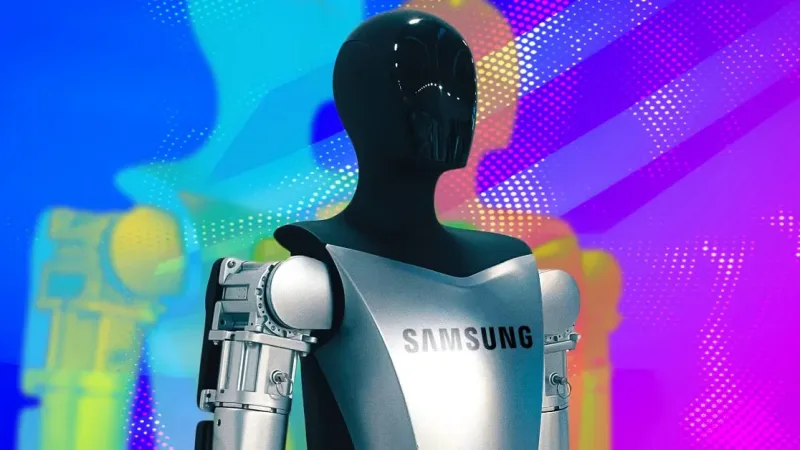

Samsung Electronics has announced that by 2030 it will convert its production lines worldwide into AI-run autonomous factories. The plan calls for humanoid robots to handle everything—production management, materials transport, even assembly. Why would a company built on semiconductors and smartphones suddenly go all in on robots?
The framework that answers that question was already on the books back in 1957: the Ansoff Matrix.
What the Ansoff Matrix Is
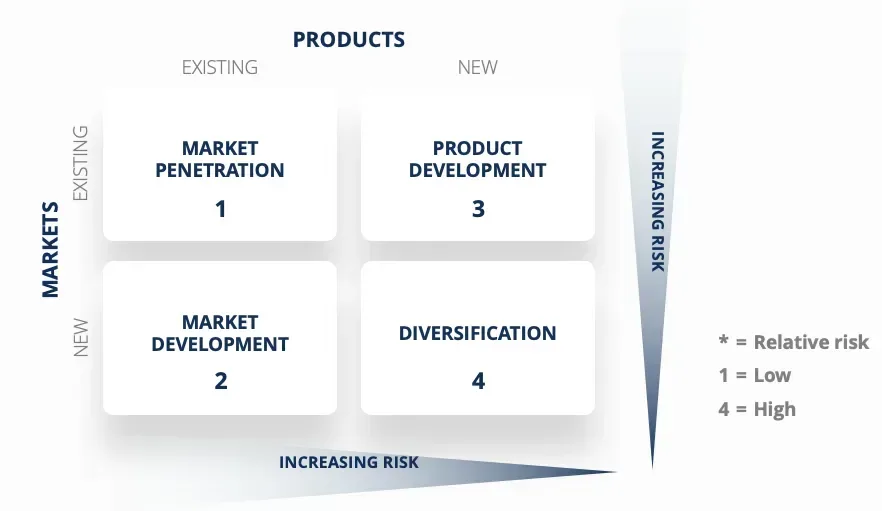
The Ansoff Matrix comes from Igor Ansoff, a Russian-born mathematician turned management theorist, who introduced it in the Harvard Business Review. It sorts the growth paths open to a company into four boxes. The horizontal axis is 'product' (existing vs. new); the vertical axis is 'market' (existing vs. new).
https://corporatefinanceinstitute.com/resources/management/ansoff-matrix/
Market penetration — existing product × existing market. The strategy of selling more of what you already sell, in the same market. Discounts, promotions, and loyalty programs all live here. It carries the least risk.
Market development — existing product × new market. Selling the same product to a new region or a new set of customers. Think of taking a service that thrives at home and carrying it abroad, or stretching a B2B product into B2C.
Product development — new product × existing market. Building something new for the customers you already have. Selling AirPods to people who already buy iPhones, or a café adding a dessert line, belongs here.
Diversification — new product × new market. Launching a new product into a new market. It's the riskiest of the four, but pull it off and an entirely new revenue stream opens up.
Seen Through Real 2026 Cases
Samsung's bet on humanoid robots is textbook diversification. It's putting a product it never made before (robots) into a market it was never in (running autonomous factories as a service). It leans on existing assets—semiconductor know-how, AI capability, manufacturing experience—but both the market and the product are new.
Coupang's path is even more by-the-book. It started with market penetration, using Rocket Delivery as a weapon to drive up its share of the e-commerce market. Then it moved into product development, adding Coupang Eats (food delivery) and Coupang Play (video) for those same customers. Now it's in the market-development phase, having launched Rocket Delivery in Taiwan. It's a single company stepping through all four quadrants of the Ansoff Matrix in order.
Naver looks much the same. Search (market penetration) → commerce and webtoons (product development) → Japan and Southeast Asia (market development) → AI and robotics (diversification). At each step it uses its existing assets as a lever to reach the next box.
Naver's step-by-step growth strategy
It Works for Small Businesses, Too
This may sound like a story about giant corporations, but the matrix works just as well for the owner of a corner café or a one-person business.
Say there's a café selling coffee in the neighborhood. Introducing a loyalty card to bring regulars back more often is market penetration. Running a dessert class at that same café, or launching a coffee-bean subscription, is product development. Pitching a catering service to a nearby office complex is market development, and learning to roast beans to start supplying other businesses (B2B) is diversification.
The point isn't to chase all four paths at once—it's to figure out which box your business is in right now, then decide on the next single box. Ansoff himself called the simultaneous pursuit of market penetration, market development, and product development "a sign of a well-managed business," but he warned that diversification alone should be attempted only once the other three are stable. You'll find this matrix and other practical strategy models in Paul Hague's Business Strategy 50.
Why a 67-Year-Old Tool Still Works
The Ansoff Matrix dates to 1957—an era with no AI, no platforms, no SaaS. And yet Samsung's 2026 robot strategy, Coupang's overseas expansion, and a neighborhood café's subscription service all map onto the same four boxes.
In the end, a business can grow in only two directions: change who you sell to, or change what you sell. The combinations of those two axes give you the four boxes, and no company grows outside them. Take a moment to sketch where your own business sits right now. The next box starts to come into view.