You know the feeling: payday arrives, your bank balance swells for a moment, and within a day or two it deflates right back down. Rent and loan interest go out, then phone bills and subscriptions get skimmed off one by one, and what's left is thinner than you'd hoped. It's no accident that Korean slang has a term for this — a "hollow account" (텅장), the paycheck that seems to pass straight through without ever really landing. Behind that letdown lurks a colder question: if your income stopped tomorrow, how many months could you actually survive? Anyone who has asked themselves that question has already grasped, in their gut, one of the most important concepts in accounting.
It's Not Revenue Size — It's the Size of Your Cushion
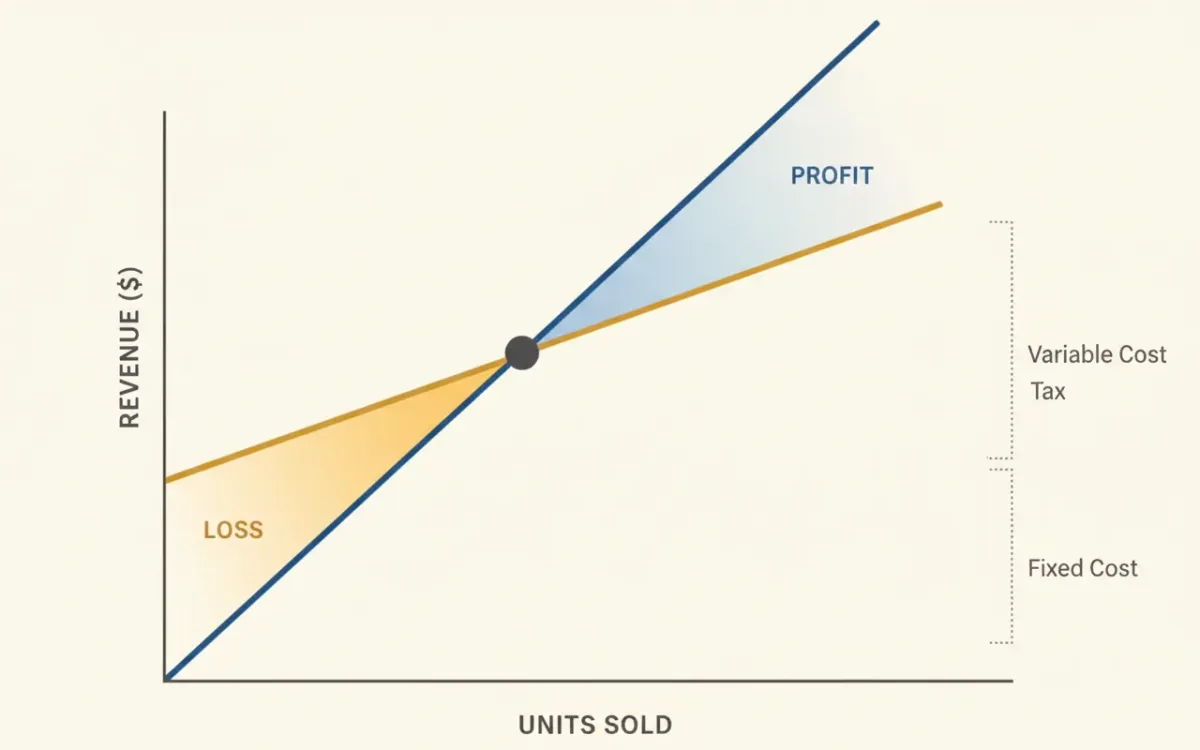
The same question exists in the world of business. We tend to judge a company's health by the size of its revenue, but the line that actually separates survival from collapse lies elsewhere. Accountants call it the break-even point: the exact spot where money coming in equals money going out, and the moment revenue dips below it, losses begin. For a company, this line is its survival line. Fall short of it, and the harder you work, the more you lose — an oddly cruel position to be in.
But clearing that survival line is no guarantee of safety. What really matters is how far above the line current revenue sits — in other words, how much of a cushion, or "margin of safety," has been built up. That margin is the breathing room a company has above its survival line, the buffer that keeps it from tumbling into the red when revenue wobbles. That's why a company with big revenue and a company with a wide margin of safety are not the same thing at all. Some companies post dazzling top-line numbers while standing precariously just above their survival line; others, smaller in scale, sit comfortably far from that line with room to spare. When the economy shakes, it's usually the first kind that falls first.
My Survival Line, My Line of Defense
Lay this framework over your own household budget, and the true nature of the "hollow account" phenomenon comes into focus. The sum of your fixed costs — rent, loan interest, insurance premiums, subscriptions — is your personal break-even point. What's left of your income after that line is your own margin of safety. That's precisely why an empty account feels so unsettling: it's not really the balance number that's alarming, it's the signal that your margin of safety has worn thin. A life with a thin margin of safety gets knocked below the survival line by the smallest shock. A sudden medical bill or an unexpected gap in income — ordinary variables — are enough to tip the whole structure straight into the red.
The solution follows the same logic. There are only two ways to widen your margin of safety: increase income, or lower the break-even point itself. And the one that's usually within immediate reach is the latter. Trimming even a single line of fixed expense pulls your survival line downward, opening up breathing room even with the same income. Canceling a subscription you no longer use, or chipping away at loan principal, might look trivial, but through an accountant's eyes, it's a structural change that actually moves the survival line. Even the effort to build up a few months' worth of living expenses as an emergency fund is, in the end, a way of securing your margin of safety measured in time.
The instinct for reading numbers isn't something you need only in front of a financial statement. Tonight, try opening your household ledger, listing out your fixed expenses, and gauging where your own survival line falls — and how much room you've secured above it. The eye that reads a company's fate and the eye that safeguards your own life start from exactly the same place.