
The 7 Difficult-Customer Situations Every Café Owner Needs to Know How to Handle
"It's not that being the boss hurts — it's that not knowing hurt."
Running a café or any other service business, the hardest part is dealing with people. Customers who sit down without ordering, ask to split one drink among several people, come in just to use the restroom, park illegally out front, bring in outside food, or rearrange the tables — these situations keep coming up, and they wear owners down. But that's not the owner's fault. If you prepare and rehearse how to respond to each situation ahead of time, you can cut the psychological toll dramatically. The key is to have your scripted responses and posted signage ready from day one — lines you can deliver calmly, with a smile, without ever raising your voice.
Why These Situations Wear Owners Down
Everyone in the service industry has heard that dealing with people is the hardest part of the job. But almost no one teaches you what to actually do when a difficult customer shows up. Business-startup courses will tell you that you'll encounter all kinds of customers, but they stop there — they never cover exactly what to say or how to act. So owners end up learning, by default, that they're just supposed to grit their teeth and put up with every uncomfortable situation.
The trouble is that these situations keep repeating. When you don't know how to handle them, you start blaming yourself for everything — "maybe I should have been more patient," "maybe I'm just not cut out for this" — and your stress levels only climb. That's why so many owners end up saying "it hurts because I'm the boss." But the truth is, it hurt because they didn't know. Not everything has to be learned the hard way — some things you just need to be told.
Seven Situations, Seven Ways to Handle Them
1. Customers Who Don't Order
Say a group of five is coming, but three of them arrive early and sit down first. You wait for an order that never comes, and before long they're just sitting there. In a small shop especially, a table held without an order means one less table for everyone else.
How to handle it: Say something — that's the right answer. Even if it feels awkward, walk over and let them know they need to order. If speaking up feels too hard, put together a posted policy alongside your menu board from the very start. Some customers will get offended and walk out when you mention it. If that happens, don't beat yourself up wondering what you did wrong. The customer who didn't order is the one in the wrong, not you.
2. Splitting One Drink Between Several People (Extra-Cup Requests)
Four people come in, order two drinks, and ask for two extra cups so they can split them. They'll often explain themselves — "it's too strong," "one drink is too much for me" — but multiply this over time and it takes a real bite out of revenue and operations. That's exactly why so many cafés now post a "one drink per person" sign on their tables.
How to handle it: Even if you do bring the extra cups, say gently, "I'm afraid we can't do split servings — please be sure to order one each next time." Practice saying this ahead of time until it comes out naturally. This isn't a "I just can't say that" situation — it's simply something you have to do. It's far more efficient to build a "one drink per person" line into your official signage from the day you open.
3. Refill Requests
Some customers finish their drink and ask, "Could I get a refill? It wasn't quite enough." You sold that first drink for money — the next one, if you say yes, is free.
How to handle it: Decide your refill policy ahead of time. You have two real options — offer refills at 50% off, or, for a specific drink like an Americano, batch-brew a dedicated refill version each morning and offer that instead. Keep in mind that allowing refills can spiral into other issues: customers taking a refill in a tumbler and coming back later for another, or splitting the refill among a bigger group. If it starts getting complicated, it's better to adopt a flat no-refills policy. What matters most is deciding the policy before you need it, not in the moment.
4. Customers Who Only Want the Restroom
Some people walk in without ordering and ask, "Can I use your restroom?" You might let it slide the first time, but once it happens every day, it starts to weigh on you. Your restroom is not a public restroom.
How to handle it: It's fine to say no, firmly. In Europe, it's already standard practice that the restroom is for paying customers only. Some people will push back — "so I have to buy a drink just to use the bathroom?" — and if that creates an awkward moment, that's not on you. Post a sign that reads "Restroom for customers only" and back it up verbally when needed. This is exactly the kind of standard you need if you want to stay in business for the long haul.
5. Parking Without Actually Being a Customer
A customer says, "I'll just park out front for a minute," orders a drink, finishes it, then says, "I'm going to run an errand," and leaves the car parked while they disappear. They were a customer while they were drinking — after that, they're just someone using your parking space.
How to handle it: Say plainly, "The parking spot is only for customers while they're here." That applies to regulars too. It might feel harsh, but it isn't — and you can still use judgment and flex on a case-by-case basis. What matters is setting the rule (the manual) first, and then deciding within that framework. Without a rule, you'll end up handling every situation differently, and that inconsistency is what wears you out.
6. Outside Food
Some customers bring in a cake for a party and ask for plates, or simply eat food they brought from outside. Lately, more people are also bringing in drinks from other places in their own tumblers. One café went so far as to post a sign on its tables reading, "Outside food will result in removal from the premises."
How to handle it: It's fine to walk over and say something when you see outside food — bringing it in shows a lack of respect for the space you've built. Don't say it angrily or with a sour look; just say, calmly and with a smile, "I'm sorry, but outside food isn't allowed here." Some customers will call you inflexible or difficult. But the moment those same people open their own business, they'll say the exact same thing to their customers. This is a legitimate skill for running a business, not pettiness.
7. Moving Tables Without Asking
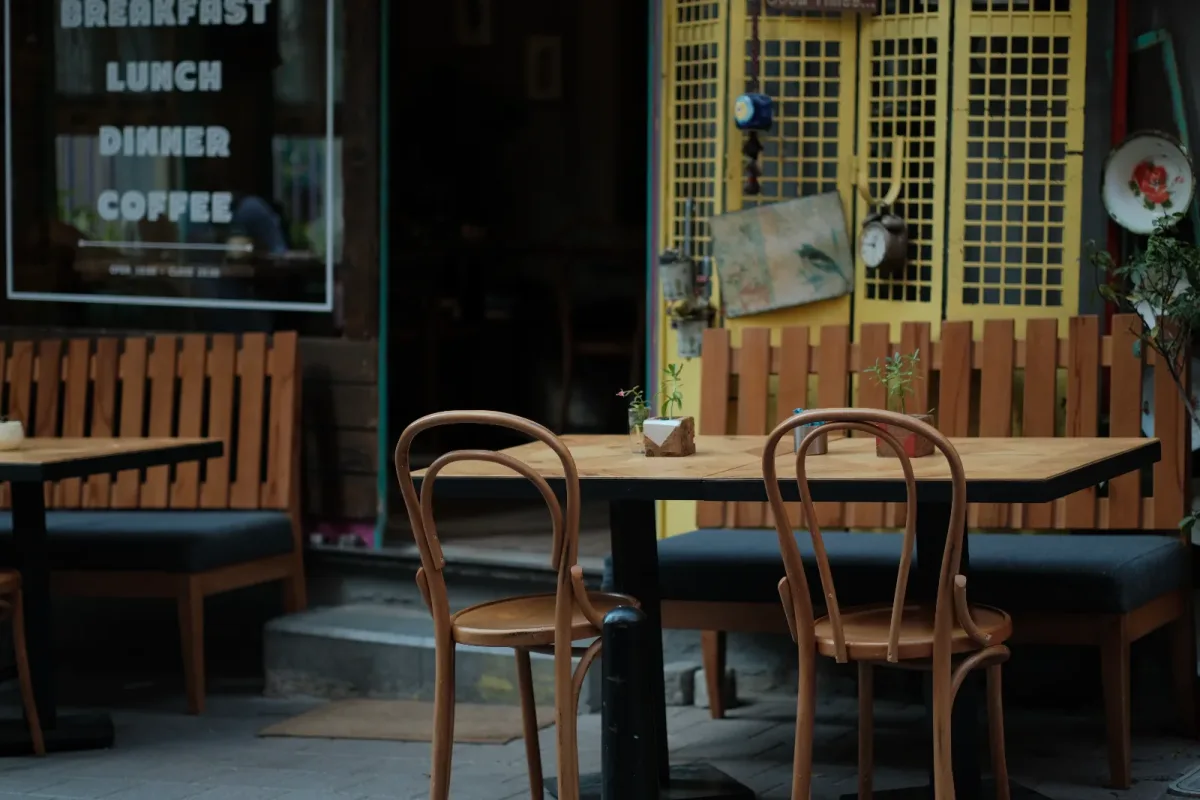
This is exactly why Starbucks makes its tables so heavy. In Korea, people tend to treat rearranging tables as no big deal. Almost no one asks, "Would it be all right if I moved this table?" They just push tables together, or move one aside to drape a coat over it or set down a bag. In a small shop, moving even one table can mean an entire seat disappears.
How to handle it: The most realistic fix is to choose heavy tables from the start. Lightweight tables get moved almost 100% of the time, so it's far better to build fixed or heavy tables into your interior plan from the design stage. Making it structurally difficult to move tables in the first place beats posting a "do not move tables" sign after the fact.
Being Kind Is Not the Same as Being Close
There's one principle you need to hold onto while running a business: being kind and being close are two completely different things.
Kindness is an attitude every owner needs. Getting close to customers is something else entirely. Once you have regulars, some of them will naturally start pushing past boundaries — treating parking favors, refills, or special exceptions as things they're owed. This space isn't a venue for personal gatherings, and the relationship between owner and customer isn't a friendship. The more regular a customer is, the kinder you should be to them — while still maintaining distance. Everyone operates by the menu, and the rules apply to regulars exactly the same as anyone else.
The Takeaway
- The pain that comes from difficult customer situations isn't the owner's fault — it comes from not knowing how to respond.
- Order policies, one-drink-per-person rules, restroom policies, parking rules, outside food bans, and table-moving restrictions should all be turned into signage from the very start of your business.
- Don't tape up a hand-scrawled notice later — design your signage alongside your menu board from day one as an official part of your space.
- When you need to speak up about an uncomfortable situation, practice ahead of time so you can say it calmly, with a smile, without ever raising your voice.
- Choose heavy tables from the start so that moving them is structurally difficult — that's the realistic solution.
- Kindness and closeness are not the same thing. Be kinder to regulars, but always keep your distance.
- All of this comes down to operational skill — the kind that lets you run your business efficiently and stay in it for the long haul.