

Not long ago, when we talked about competence, we pictured the number of certifications you held, your foreign-language test scores, your specialized knowledge—the things you could measure and list on a résumé. But as AI takes over that territory, the value of what's hard to measure is rising.
The Bank of Korea ran an analysis of how likely each profession is to be replaced by AI. Doctors and traditional Korean-medicine physicians topped the list at 99%. Accountants came in at 81%, and judges, prosecutors, and lawyers at 79%. Bodyguards and singers, on the other hand, sat at 0%, and childcare workers at 25%.
Doesn't that strike you as strange? The jobs that demand the longest schooling and pay the highest salaries are the first to be replaced.
This is what's known as Moravec's Paradox: the things that are hard for humans—math, logic, legal interpretation—are easy for AI, while the things that are easy for humans—walking, manual dexterity, reading facial expressions—are hard for AI. The hierarchy of professions that people have trusted for decades is being turned completely on its head.
A 30-Million-Won Desk Job vs. a 70-Million-Won Trade
The job platform Catch surveyed Gen Z job seekers. Asked to choose between a white-collar job paying 30 million won a year (roughly $22,000) and a blue-collar job paying 70 million won (roughly $51,000), more of them picked blue-collar. Their reasons were clear: higher pay (67%), a lower risk of being laid off (13%), and less stress from overtime and the climb for promotions.
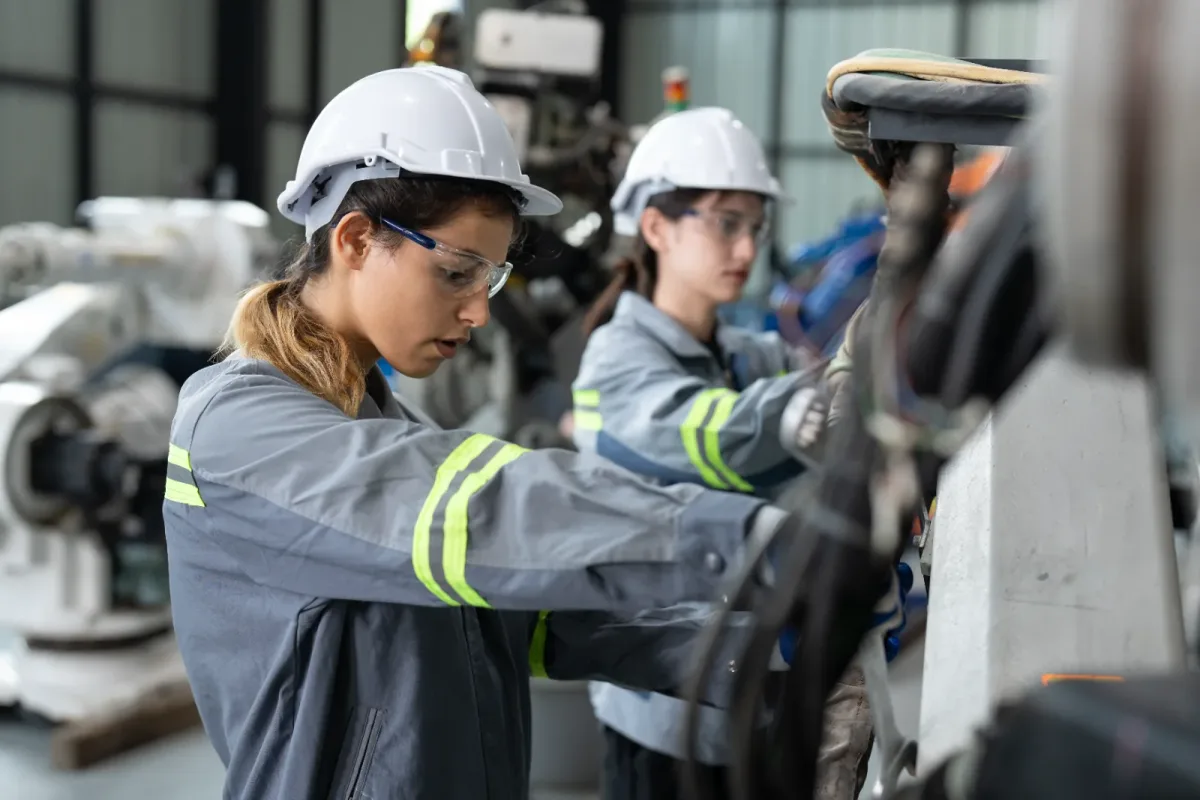
And sure enough, you can now spot people in their 20s and 30s on wallpapering, tiling, and plumbing jobs without much trouble. Trades that were once avoided are being reassessed as "jobs that are safe from AI."
But that leaves one uncomfortable question. So what are the people working in offices supposed to do?
Skill and Knowledge Already Belong to AI
The Korea Development Institute (KDI) published a report warning that, if the current labor-market system holds, up to 90% of human labor could be replaced by 2030. In the United States, the payments company Block cut a workforce of more than 10,000 employees to fewer than 6,000—more than 40% of its staff, gone.
There's a common thread. The people being replaced had competencies concentrated in "skill" and "knowledge"—the ability to work Excel well, the memorized knowledge of legal statutes, the skill of organizing data. AI does all of these faster, more accurately, and more cheaply.
So what's left?
A survey of 1,532 people by Dooit Survey and Research & Lab offers an intriguing answer. The keywords people kept naming for "competencies AI can't easily replace" were on-the-ground judgment, on-the-spot problem-solving, and emotional connection. These are neither skill nor knowledge.
They're attitude.
The Age When Attitude Becomes Competence
Making a call in an uncertain situation. Finding the next move in front of a failed project. Forging a consensus in a meeting room where opinions collide. None of this can be learned from a manual, and there's no data for AI to train on.
The OECD is saying the same thing. The job changes driven by AI aren't simple replacement but a reconfiguration of roles, and alongside technical ability, distinctly human capacities—creativity, critical thinking, emotional intelligence—will only become more important.
In the end, the defensive line of a career is shifting from "what do I know" to "what kind of person am I."
There's no need to fear AI. But if you've assumed that the skills and knowledge you've stacked up are the sum of who you are, that belief is worth a second look. Because what AI can't take, in the end, is what only comes from people.