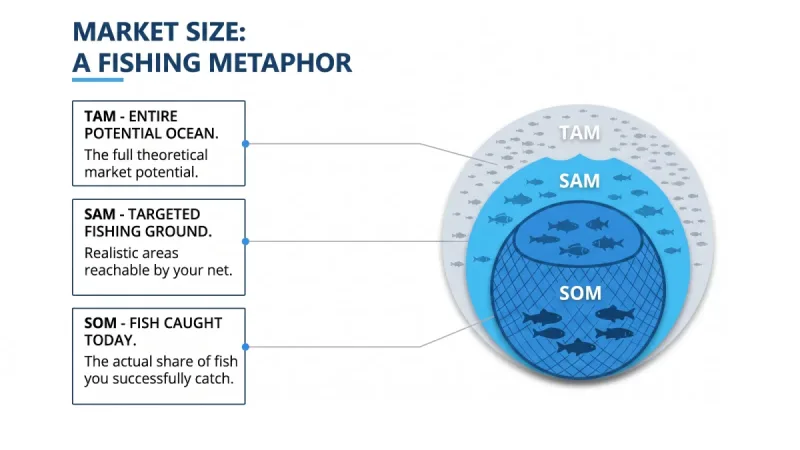

When someone asks how big your market is, answer with three numbers
Tell an investor, "Our market is worth 100 trillion won," and the response is always the same: "Sure — but how much of that can you actually capture?"
A 100-trillion-won market existing is one thing. Your business actually making money in that market is something else entirely. The framework that lays out this difference, structurally, is TAM, SAM, and SOM.
If you're a founder, a PM, or a business planner, these are must-know concepts — and yet they get muddled surprisingly often. Here's the clean version.
A fishing analogy makes it click
Picture how many fish are in the sea.
TAM is every fish in the ocean. How many tuna are in the entire Pacific. It's the total size of the market in theory — the full demand that exists out there, whether or not you can ever catch any of it.
SAM is the fish in the waters your boat can actually reach. Not the whole Pacific — only the fish within your boat's range, of the kind your nets can catch. It's the slice of the market your product can realistically serve.
SOM is the fish you'll actually haul in today. Given the size of your boat, your crew, your fuel, and the number of rival boats out there, it's what you can realistically land. It's the revenue you can capture with the capabilities you have right now.
Telling the three apart, precisely
TAM (Total Addressable Market) — the total market
TAM is the total market size you'd have if every potential customer with the problem your product solves bought your product. With no limits of geography, competition, or capability, it's the theoretical ceiling.
Say you're building an online English-learning service. Your TAM is everyone in the world who wants to learn English — potentially billions of people. It isn't realistic, but it shows where the ceiling of the market sits.
TAM matters because if this number is too small, no amount of execution will turn it into a meaningful business. Investors look at TAM to judge one thing: is this market big enough to be worth investing in?
SAM (Serviceable Addressable Market) — the market you can serve
SAM is the portion of TAM your product can actually reach. It's the market left after filtering by geography, language, price point, distribution channel, and the nature of your product.
Take that same online English service. If you offer it in Korean and only support Korean payment systems, your SAM narrows to "adults in Korea who want to learn English online." That's a slice of the TAM.
SAM is the realistic arena for your business. It shows how big the market is that your product can actually compete in.
SOM (Serviceable Obtainable Market) — the market you can win
SOM is the revenue you can realistically capture within a short window — usually one to three years — out of your SAM. It's a number that honestly reflects your current marketing budget, sales team, brand awareness, and competitive landscape.
Even if Korea's online English-education market (your SAM) is 500 billion won, a 2% share in your first year makes your SOM 10 billion won. That becomes the revenue target in your actual business plan.
SOM is the most realistic number of the three, and it's the one investors scrutinize most closely for evidence. You need a convincing answer to "Why do you think you can take that 2%?"
Thinking it through with a real example
Suppose you're launching a health-food subscription service for pets.
TAM. The global pet-food market — roughly 150 trillion won. That includes kibble, treats, health food, and supplements. You'll never eat the whole thing, but the market itself is plenty big.
SAM. The premium dog health-food market in Korea. Out of all pet food, keep only the health-food category; within that, only dogs; within that, only the premium price tier. Call it roughly 300 billion won.
SOM. The customers you can win in year one: the Seoul–Gyeonggi region, owners of small dogs, on a monthly subscription model. Factoring in your marketing budget and logistics capacity, that's 5,000 monthly subscribers and about 3 billion won in annual revenue. That's a realistic first-year target.
Same business, and the numbers narrow from 150 trillion → 300 billion → 3 billion won. You have to show all three together to convey both the size of the opportunity (the chance) and the realism of execution (the plan) at once.
Three common mistakes
First, inflating TAM and showing only that. "The AI market is worth 1,000 trillion won" sounds impressive, but it means nothing if you can't then say what your product's SAM and SOM are. Investors care less about the size of your TAM than about the logic of how you narrow from TAM down to SOM.
Second, confusing SAM with SOM. "The Korean market is 500 billion won, so our revenue target is 500 billion won" makes no sense. SAM is the entire serviceable market, competitors included; SOM is the share of it you can actually take. No business plan assumes 100% market share.
Third, setting SOM too conservatively. Go the other way and lowball your SOM, and you can't make the case for why anyone should invest at all. SOM should be realistic but ambitious. What matters isn't the size of the number — it's pairing it with a concrete path (channels, strategy, resources) for actually reaching it.
When you run the math, there are two approaches.
Top-Down
You start from big market data and narrow down. Pull the total market size (TAM) from an industry report, filter by region, category, and price tier to get SAM, then multiply by an expected market share to arrive at SOM.
The upside is that it's fast and good for painting the big picture. The downside is that the numbers are abstract, so it's weak against the question "Okay, but what's your basis for that?"
Bottom-Up
You start from small units and build up. Annual spend per customer × the number of customers you can win = SOM. From the share that SOM represents of the whole market, you work backward to SAM and TAM.
The upside is that the numbers have concrete grounding. The downside is that you can lose sight of the market's big picture.
In practice you do both. Use top-down to show the size of the market, and bottom-up to prove the realism of your execution plan. If the two approaches produce wildly different numbers, an assumption somewhere is wrong.
How to put it in a business plan
When you present to investors, this order flows naturally.
Start with TAM to show the size of the opportunity: "This market is big enough." Then narrow the focus with SAM: "Here's the slice of it where we compete." Finally, lay out the execution plan with SOM: "In year one we'll capture this much, this way."
Then show the path that expands from SOM to SAM, and from SAM to TAM: "Start in Seoul and go nationwide; start in Korea and go across Asia." That expansion path becomes your business's growth story.
In a single line: TAM is the size of the dream, SAM is the stage you can fight on, SOM is tomorrow's revenue. Show all three together, and you convey both the potential and the realism of the business at once.