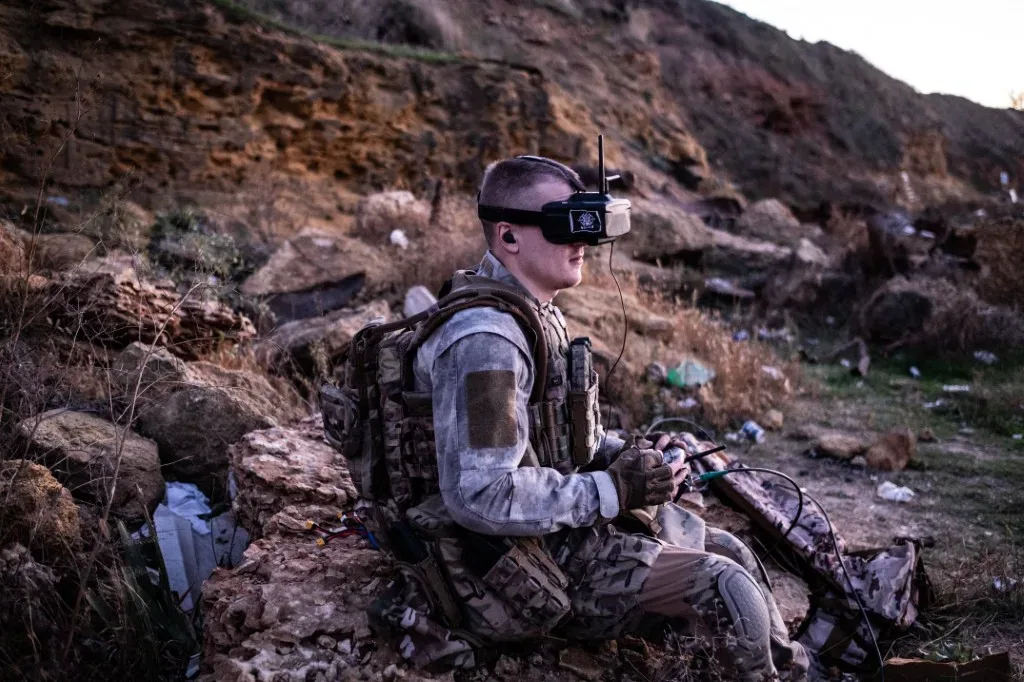
When a new tool arrives, organizations usually do one of two things: teach people to buy it and use it, or teach them what it's actually made of.
The first path is faster and cheaper, and most of the time it's enough. The split shows up when the tool stops being available to buy, or when circumstances change and it needs to be modified. Those who only learned to use it stop right there.
One of South Korea's largest technology-training programs right now sits at exactly this fork. The Ministry of National Defense has set a goal of training 500,000 drone soldiers, and in 2026 it is distributing roughly 11,000 commercial off-the-shelf training drones.
What the word 'commercial' means here is what defines the whole program.
Learn on a Finished Product, and All You Keep Is How to Use a Finished Product
A commercial drone is a finished product — a machine you buy and fly through an app.
And China controls that finished-product market. According to a June 2026 Korea Economic TV report, there were cases in military drone procurement where Chinese-made drones were chosen over domestic ones, and a tip surfaced that most of the key components on display at the booth of a company claiming 100% domestic parts were in fact made in China.
The problem isn't just procurement. Learn on a finished product, and all you keep is how to use a finished product.
Say 500,000 soldiers are trained to open an app and press takeoff. When those 500,000 reach the front line, what can they do if jamming cuts the signal? Do they know where to intervene to convert the drone to a tethered cable link? If a propeller snaps, can they swap in a different size?
What produced Ukraine's fiber-optic drones wasn't skill at operating a finished product. It was the ability to combine and swap components. The whole chain — running into jamming, switching the control link to cable, running into cable breakage, and bolting on a radio backup — turns on assembly knowledge.
Training that only teaches you to buy and fly a finished product can't enter that chain, because the moment what you could buy runs out, so does your capability.
What the Builders Could Do
An FPV drone splits into two systems: the one that flies the airframe, and the one that serves as the pilot's eyes.
On the flight side, a flight controller, electronic speed controllers, motors, propellers, and a battery all mount to the frame. On the vision side, a camera captures what it sees, a video transmitter broadcasts it over radio, and an antenna receives it.
What the fiber-optic airframe changed is just one of these — the path the signal travels.
The frame, the motors, the battery — all the same. One extra part gets added, a spool that holds the cable, and the added weight cuts into how much payload the drone can carry. If the cable breaks, the drone is lost. In March 2026, a hybrid system that switches to radio if the cable breaks was unveiled, reportedly adding around $60 to the cost.
In other words, the battlefield version isn't a different kind of machine. It's the same structure with one part swapped out.
Building It Is How You Learn It
There is effectively no finished, ready-to-fly product for 5-inch FPV drones. The hobby is structured so you can't start without assembling one yourself.
At first this looks like a barrier to entry. But the knowledge this hobby is really about lives inside that assembly process — calculating whether the ESC and battery can handle the current the motors draw, choosing a KV rating that matches the cell count and propeller, checking thrust-to-weight margin against the drone's total weight.
It's the same kind of judgment a battlefield technician makes when modifying an airframe. Only the scale and the purpose differ.
So the hobby's barrier to entry isn't really a barrier — it's a curriculum. There's knowledge inside it that you can't learn any way other than by building.
Given the scale and budget involved, it's understandable that the training program chose finished products. But it's worth being clear-eyed about what that choice leaves behind, and what it doesn't.
This Split Isn't Unique to Drones
The same fork shows up with other tools.
Look at any team using AI tools and you'll find two layers: one that feeds a service prompts and takes the output, and one that understands why the output came out that way and can rework the input structure. The first layer stalls the moment a service raises its prices or changes its policies. The second adapts — switching models or restructuring its approach.
No-code tools are no different. Assembling screens into an app is one thing; understanding how data actually moves underneath is another. The split shows up the moment a request comes in that the tool doesn't support.
The common thread is this: staying at the finished-product layer is fast, but that layer only extends as far as the range the provider has set. Once that range shifts, you're out of options.
So the question to ask when new technology arrives isn't "Do I know how to use this tool?" It's "What can I do when I can no longer use it?" The answer is the real capability that organization or individual actually has.
What to Do Next
Pick one tool you rely on right now and ask this question: what could you do if the supply cut off or the terms changed? If an alternative doesn't come to mind immediately, that tool isn't a capability — it's a dependency.
If you read this piece because drones caught your interest, the starting point isn't a finished product — it's assembly. Since 5-inch FPV drones have effectively no ready-made option, the hobby forces you to start by building. That constraint is exactly what makes you learn.
The FPV Drone Bible walks through that process part by part. It covers what each of the seven components, from frame to battery, actually does, how the three FPV subsystems transmit video, and the actual sequence for soldering them together. If you've ever wondered what the drone in the news is actually made of, the answer is in there.