
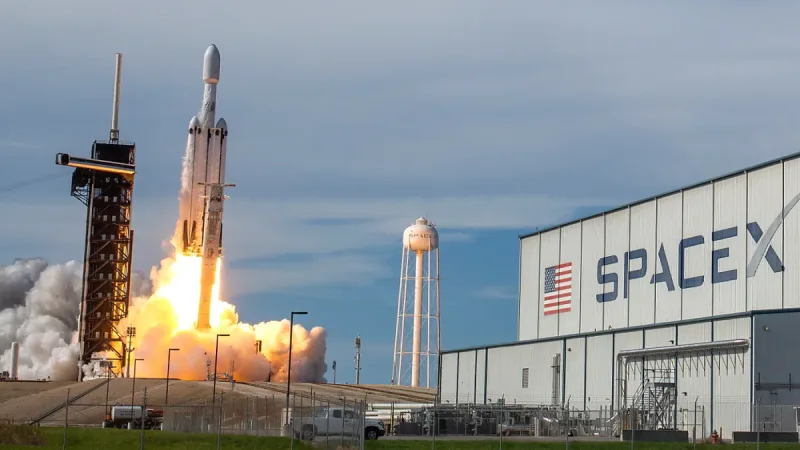

The New Kind of Company SpaceX Built
Since its founding in 2002, SpaceX has grown for 22 years on private capital alone. It has locked in NASA contracts, satellite launch services, and an independent revenue stream in Starlink. That's a world away from traditional aerospace companies, which have historically leaned heavily on government funding.
So where does SpaceX's real value lie? In space infrastructure. Rocket launches are just the means to an end — it's Starlink, the satellite communications network, that's generating the real revenue. SpaceX is the only company that has put more than 4,000 satellites into low Earth orbit.
Starlink now operates in roughly 100 countries and has surpassed 4 million subscribers. At a monthly subscription fee of $99 to $120, that works out to roughly $5 billion in annual revenue — a striking figure that accounts for about half of SpaceX's total sales.
Three Business Lines Investors Should Watch
Launch Services is SpaceX's foundational business. Its Falcon 9 and Falcon Heavy rockets handle satellite launches, cargo runs to the International Space Station, and military missions. The key breakthrough is reusable rocket technology, which has cut launch costs by roughly 90% compared to previous norms. In 2024, SpaceX logged more than 100 launches in a single year.
Starlink is currently the company's biggest revenue driver. The low-Earth-orbit satellite internet service delivers high-speed connectivity to regions that traditional ground infrastructure can't reach. Its demonstrated military utility in the war in Ukraine has also helped drive a growing pipeline of government contracts.
The Starship program is SpaceX's bet on the future. This massive rocket, designed with Mars colonization in mind, could completely rewrite the paradigm for space travel and cargo transport if it succeeds. It's still in development, but its selection for NASA's lunar lander program has already validated its commercial potential.
The Ripple Effects on the IPO Market
So what's the real significance of a SpaceX IPO? It could trigger a "listing rush" among late-stage unicorns. Companies like OpenAI, Stripe, and Databricks — which have all postponed going public for years — could move in quick succession. What they have in common: all are valued north of $100 billion.
Demand for SpaceX shares on the secondary market has surged since 2024, and employees have been increasingly active in cashing out stock options. That's a signal that early investors are under mounting pressure to secure liquidity before an IPO.
That's precisely why 2026 could mark a turning point for the IPO market. If SpaceX lists successfully, a flood of unicorn listings could well follow in its wake.
Risk Factors Individual Investors Should Know
That said, investing in SpaceX carries clear risks. The first is regulatory risk. The space industry is highly sensitive to shifting government regulations worldwide. As technological competition with China intensifies, national-security-driven sanctions or tighter regulation could follow.
The second is technology risk. If the Starship program fails or is delayed, it undermines SpaceX's long-term growth engine. The program has already seen multiple explosions and failures during test launches. Given the nature of space technology, a single major accident could deal a blow to the entire business.
The third is intensifying competition risk. Amazon's Project Kuiper and China's state-run space companies are all racing to catch up with SpaceX. How long Starlink can hold onto its dominant position remains an open question.
Investment Approach and Takeaways
How should investors think about a SpaceX IPO? This goes beyond a simple stock pick — it's a bet on an industry-wide transition. What matters most is how you assess the growth potential of the space economy as a whole. Morgan Stanley projects the space economy will be worth $1 trillion by 2050.
There are two ways to think about a SpaceX investment. The first scenario is the "infrastructure play" — viewing SpaceX as a communications infrastructure company for the space age. If Starlink cements itself as a pillar of global internet infrastructure, it could gain a real edge over traditional telecom carriers.
The second scenario is the "government contractor play" — a business model built on securing stable revenue through long-term contracts with NASA and the Department of Defense. As space development increasingly becomes a matter of national strategy, government orders are likely to keep growing.
For individual investors, though, diversifying into space-industry ETFs or related companies is a more realistic approach than direct investment. Following a SpaceX IPO, a broad re-rating of aerospace, satellite communications, and space-technology stocks is likely to follow.
In the end, a SpaceX listing wouldn't just be one company's IPO — it could serve as the starting gun for the space age itself. Now is the time for investors to focus less on individual companies and more on the paradigm shift unfolding across the entire industry.


