
Everyone knows the restaurant business is tough. According to a survey by Korea's Ministry of Agriculture, Food and Rural Affairs, the operating margin of domestic restaurants fell to 8.7% in 2024, down from the year before. Sales inched up just 1.4%.
Yet over the same period, one restaurant brand posted a 50.9% jump in sales and an 85.3% surge in operating profit: Haidilao, the Chinese hot-pot specialist.
Haidilao Korea's revenue last year reached 117.7 billion won, crossing the 100-billion-won mark for the first time. At some locations the queue number climbs past 300, meaning a wait of more than two hours. People line up anyway. It's worth taking apart the structure that made this kind of growth possible in the middle of a downturn.
They Sell Play, Not Food
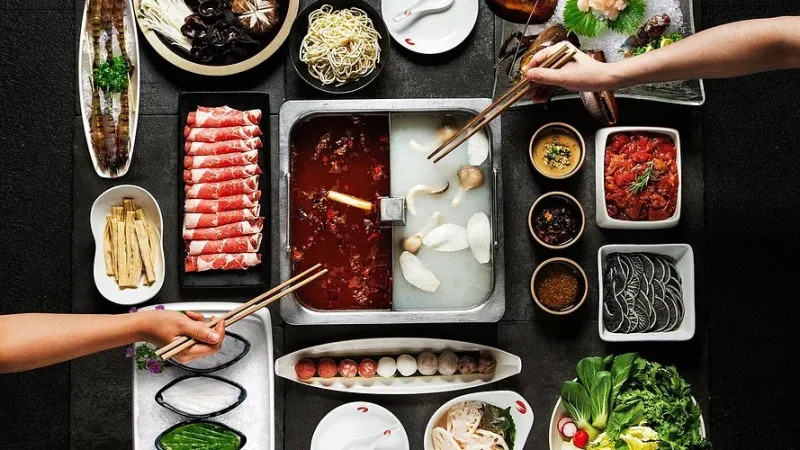
Watch what people actually do at Haidilao and it looks less like a meal than playtime. They recreate the personalized dipping-sauce recipes that celebrities share in YouTube and Instagram shorts. They wrap thin slices of beef brisket in tofu skin to cook, drop cherry tomatoes into the broth to make their own tomato soup, and turn raw eggs into noodles.
The real draw is the “freedom to combine.” Pork, beef, lamb, catfish, cod, a whole range of ingredients, plus a help-yourself salad bar. Rather than ordering a fixed menu, the act of mixing ingredients becomes the content itself. As one regular puts it, “the fun is in making my own sauce and sharing it with friends to taste.”
This isn't about how the food tastes; it's experience design. With the same ingredients, you can try a different combination on every visit, so a reason to return arises on its own. As Haidilao explains it, “customers who've tasted a new ingredient or cooking method end up coming back to taste more.”
Engineering the Feeling of Being Looked After
Fun alone doesn't explain it. Haidilao's second pillar is hospitality.
If you're wearing a birthday wristband, the staff fashion a little cake out of rice cake and a slice of cake and sing you a song. Servers eagerly recommend dishes and extend service at their own discretion. When a regular accumulates enough spending to reach Diamond tier, they get a dedicated manager, a KakaoTalk chat room, and easy reservations.
A customer's own words capture the experience precisely.
“At other restaurants, even when they call it all-you-can-eat, you'd expect some side-eye for working the salad bar like this. Here it's the opposite—the managers get into it too, saying, ‘now that looks delicious.’”
The contrast with the current mood of Korea's restaurant scene is stark. The market has split into fine dining at 200,000–300,000 won a head and value-obsessed buffets, while the restaurants priced in between are betting their survival on cost efficiency. It's an atmosphere where even a single refill of banchan (the free side dishes) draws a wary glance. Haidilao offers the feeling of being freed from that discomfort.
It Looks Like Generosity, but the Costs Are Controlled
Which raises a question. If you lavish service like this, is anything left over? The operating margin gives the answer. On 117.7 billion won in revenue, operating profit came to 20.2 billion won—a 17% margin. That's double the 8.7% average for Korea's restaurant industry.
The secret lies in the cost structure. Haidilao is closer to a food manufacturer. It doesn't cook its sauces, broths, and semi-processed ingredients in each restaurant's kitchen; it has them supplied at scale. Bulk purchasing lowers ingredient costs, and because little cooking labor is required, kitchen wages stay low too.
Service works the same way. Birthday events and extra perks aren't handed to every customer alike. They happen as the situation warrants, at staff discretion. The customer feels they've received an enormous perk, but the actual cost stays within a controllable range.
An F&B industry insider's analysis cuts right to it.
“It looks like a lot of service, but not every customer enjoys the same thing—it's done at staff discretion depending on the situation. So the customer feels they've enjoyed huge perks, while the actual cost stays controllable.”
The Formula That Works in a Downturn
Break Haidilao's strategy down and it has three layers.
First, it designs an experience the customer takes part in directly. The “play” of combining recipes drives repeat visits, and that process turns into social-media content that pulls in new customers. Without spending separately on marketing, customers do the promoting themselves.
Second, it delivers moving, high-touch service selectively. Give every customer the same service and the costs become unmanageable. It runs on staff discretion while maximizing the value customers feel. It's a structure that lets people walk out having spent 20,000–30,000 won feeling they were treated like honored guests.
Third, it shaves costs where no one can see. A large-scale supply system lowers ingredient costs, and semi-processed ingredients cut kitchen labor. The level of service customers feel goes up, while actual operating costs come down.
Professor Kim Hyun-soo of Kyung Hee University wrote in a paper that “on a foundation of high-quality ingredients and rigorous hygiene management, Haidilao delivered service capable of giving consumers a sense of delight and satisfaction that exceeded their expectations.”
This Isn't Just a Restaurant Story
The pattern among brands that grow through a downturn looks much the same across industries. Instead of cutting prices, raise the density of the experience. Cut costs without cutting the value customers feel. Instead of giving everyone the same thing, design delight selectively.
Haidilao's competitor isn't another hot-pot place. Its rivals are every dining option in the running when someone asks, “What should we eat tonight?” And the numbers prove that the way to win that contest isn't a lower price—it's a more fun, more hospitable experience.