
A small café near Hongik University in Seoul. The owner, ringing up 300,000 won (about $220) in sales a day, lets out a sigh: 'Business is slow.' Yet he has no idea what a single Americano at the next table actually costs to make, or how many cups he needs to sell in a day just to break even. He can't read the real numbers hiding behind that 300,000 won.
Behind the statistic that seven out of every ten self-employed Koreans close their doors within three years lies exactly this kind of 'number illiteracy.' They fail not because they don't keep the books, but because they can't understand the language of management that those numbers speak.
Owners Trapped by the Revenue Illusion
Most small-business owners fixate on revenue alone. 500,000 won today, 400,000 won yesterday. If sales go up, that's good; if they go down, that's bad. But this is like judging your health by body temperature alone.
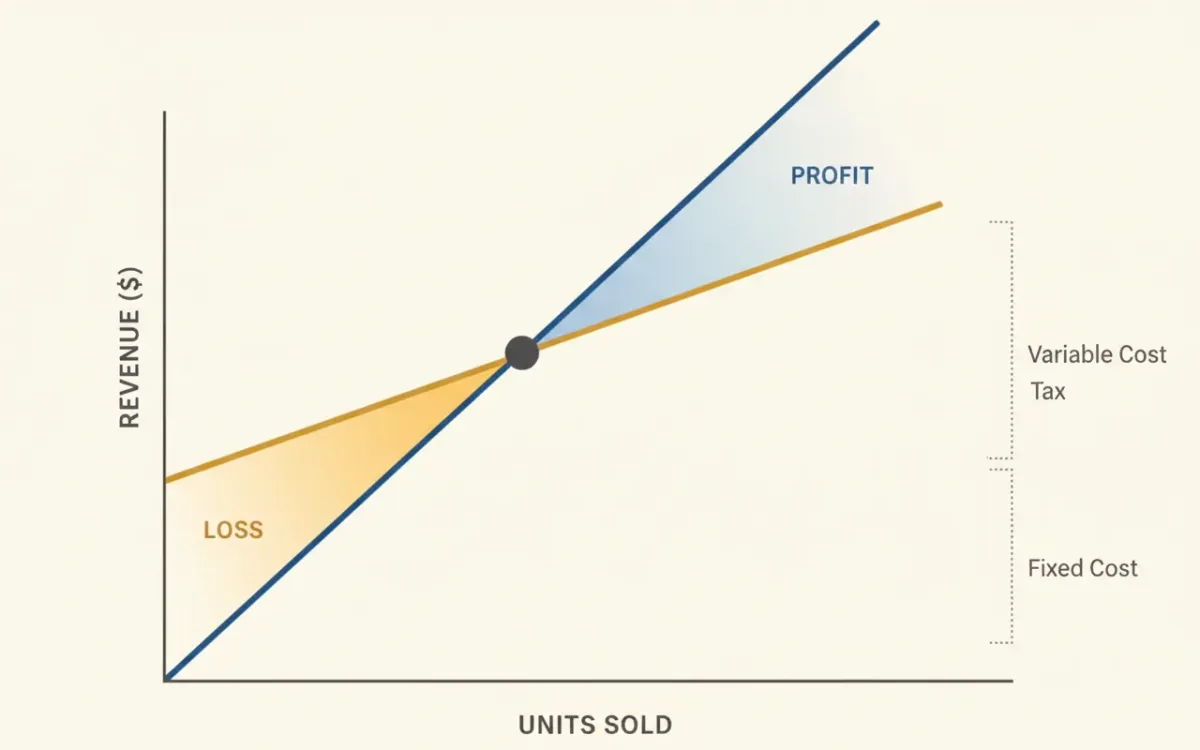
What truly matters isn't revenue—it's the contribution margin. The contribution margin is the money that actually stays in your pocket when you sell one more unit. If you sell an Americano for 4,500 won and the direct costs—beans, a disposable cup, and the like—come to 1,200 won, the contribution margin is 3,300 won.
That 3,300 won has to cover your fixed costs: rent, electricity, wages. If your monthly fixed costs run 3 million won, you have to sell at least 909 cups (3 million won ÷ 3,300 won) every month just to avoid a loss. Broken down by day, that's 30 cups.
To say 'business is bad' while failing to sell even 30 cups a day isn't a diagnosis—it's a delusion. If you don't know the cause of the problem, the solution will never come into view.
Get Your Costs Wrong and Your Prices Become Nonsense
A bakery owner in Seoul's Seongsu-dong was selling croissants for 2,800 won apiece. With 800 won in ingredients, he figured he was clearing 2,000 won. But once he factored in the oven's electricity, the packaging, and the labor to knead the dough, the real cost was 1,400 won. His contribution margin wasn't 2,000 won—it was 1,400 won.
The bigger problem was his pricing strategy. Whenever a rival café ran a promotion, he followed suit and dropped his price to 2,500 won. His contribution margin shrank to 1,100 won, yet he still believed he was pocketing 1,700 won. Because he didn't know his true costs, his pricing decisions were nonsense too.
To know a product's true cost, you have to separate direct costs from indirect costs. Direct costs are what goes straight into making that product—the flour, butter, and wrapping for a croissant. Indirect costs are shared across many products: the oven's electricity, the shop's rent, the owner's own labor.
The heart of cost accounting is deciding how much of those indirect costs to assign to each product. For a shop making 100 croissants and 50 loaves of bread, on what basis should the oven's electricity bill be divided? Split it by unit count and each croissant carries a small share; split it by oven time and the number comes out differently.
Miss the Cash Flow and Even a Profit Won't Save You
Profit on paper and cash in hand are two different things. You can ring up 1 million won in sales, but if that money doesn't come in right away, you may not be able to make rent. This is the cash-flow trap.
An interior-renovation contractor in Busan was clearing 5 million won in net profit every month. On paper, it was a thriving business. But because clients customarily paid for the work two to three months later, he was always short on cash. Staff wages and material costs went out immediately, while the money owed to him came in later—and that lag was the problem.
In the end he had to borrow operating funds from the bank, and the interest began eating into his net profit. He was in the black and still strapped for cash.
For a small business, managing cash flow is a matter of survival. You have to know exactly when revenue turns into cash and when costs go out. Credit-card sales usually settle three to four days later, while cash sales are in hand the same day. Rent and wages go out on fixed dates; material costs go out every time you buy supplies.
Mark these timings on a calendar and you can see in advance when cash is going to run short. Knowing when the squeeze is coming lets you prepare ahead of time and avoid scrambling for emergency money.
The Truth About Your Business, Told in Numbers
Management accounting isn't some complicated theory. It's a tool for translating the reality of your business into numbers. Revenue minus variable costs gives you the contribution margin; the contribution margin minus fixed costs gives you operating profit. With this one simple formula, you can diagnose the health of your business.
What matters even more is that these numbers are all connected. Lower your rent and your fixed costs fall, which pulls your break-even point down with them. Upgrade your ingredients and your variable costs rise—but you can charge more, so your contribution margin ratio may actually improve.
Numbers are a simulator that shows you the consequences of your choices before you make them. They let you work out 'what happens if I do this.' The era of running a business on gut instinct is over. This is the age of communicating in numbers, deciding by numbers, and verifying with numbers.
The success or failure of a small business no longer rides on luck or instinct. It's a structure in which the people who understand and use the language of numbers are the ones who survive. That is the difference between the owner who fails and the owner who succeeds.