
Hyundai Motor Group has announced a 9 trillion won ($6.5 billion) investment in Saemangeum, aimed at building a massive industrial complex spanning robotics, AI, and hydrogen. The project is expected to create as many as 71,000 jobs. At a moment when so many investors are searching for "the next Nvidia," it's worth talking about how the profitable segment of the AI value chain is shifting.
The Three Layers of the AI Value Chain
Break the AI industry down by value chain, and it broadly falls into three layers.
The first is "compute."
GPUs, chips, and cloud infrastructure live here. Nvidia is the poster child.
The second is "training."
Data collection, model training, and algorithm development are the core activities. OpenAI, Google, and Meta lead this layer.
The third is "execution."
This is where AI actually performs tasks in the physical world — robotics, autonomous driving, and smart factories are the flagship examples. KAIST's recently unveiled "physical AI" strategy is aimed squarely at this layer.
The problem is that most investors are still fixated on layer one — hunting for chip stocks or parsing GPU supply data. But the real money has already moved on to layer three.
What Hyundai's $6.5 Billion Investment Really Means
Look again at Hyundai's Saemangeum investment and the picture becomes clear. The plan is to complete the entire value chain — from hydrogen production to end use — within a single site in Saemangeum, layering in AI analytics and robotics along the way. This isn't a simple manufacturing investment. It's a strategy to build a complete ecosystem in the third layer of the AI value chain — "execution." AI gets folded into the hydrogen production process, robots carry out the physical work, and the entire operation gets optimized through data.
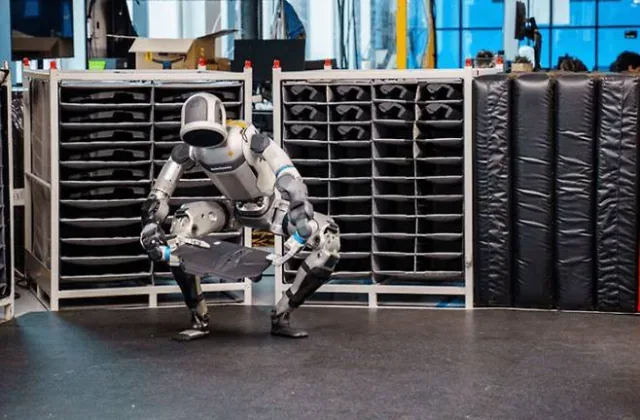
Boston DynamicsBoston Dynamics tells a similar story. What makes the company noteworthy isn't the robotics hardware itself — it's proof that AI can solve real problems in physical environments: moving boxes in warehouses, assembling parts on factory floors, standing in for humans in hazardous settings.
Five Signals Worth Watching as an Investor
So which signals should you actually track to apply this shift in the AI value chain to your investing?
First, physical infrastructure investment. Look for companies building large-scale production bases the way Hyundai is — not just IT spending, but real money going into factories and equipment.
Second, full value-chain integration. Watch for a single company trying to control the entire process, from raw materials to finished product. The Saemangeum project — spanning hydrogen production all the way through end use — fits exactly this pattern.
Third, links between labs and industrial sites. Companies building structures like KAIST's "Deep-Tech Scale-Up Valley," where research output gets applied directly to real industrial problems.
Fourth, the scale of job creation. Contrary to fears that AI destroys jobs, the execution layer is actually generating large-scale employment — which is exactly why Hyundai expects to drive 71,000 jobs.
Fifth, alignment with government policy. These aren't purely private investments — they're projects intertwined with national industrial policy. The Saemangeum investment itself is a joint undertaking between the government and Hyundai.
An Investment Thesis That Will Be Tested Within Three Years
This shift should be understood as "execution-centered investing." Rather than investing in AI technology itself, the strategy focuses on the areas where AI actually creates value. That means smart-factory companies where AI and physical production converge; companies in autonomous driving, robotics, and drones where AI directly carries out tasks; and the subsidiaries and partners of large conglomerates working to integrate the entire value chain.
The era of fixating solely on chips and GPUs is over. What matters now is what AI is actually building, and what problems it's actually solving. How do you see this shift toward a new profit zone in the AI value chain?