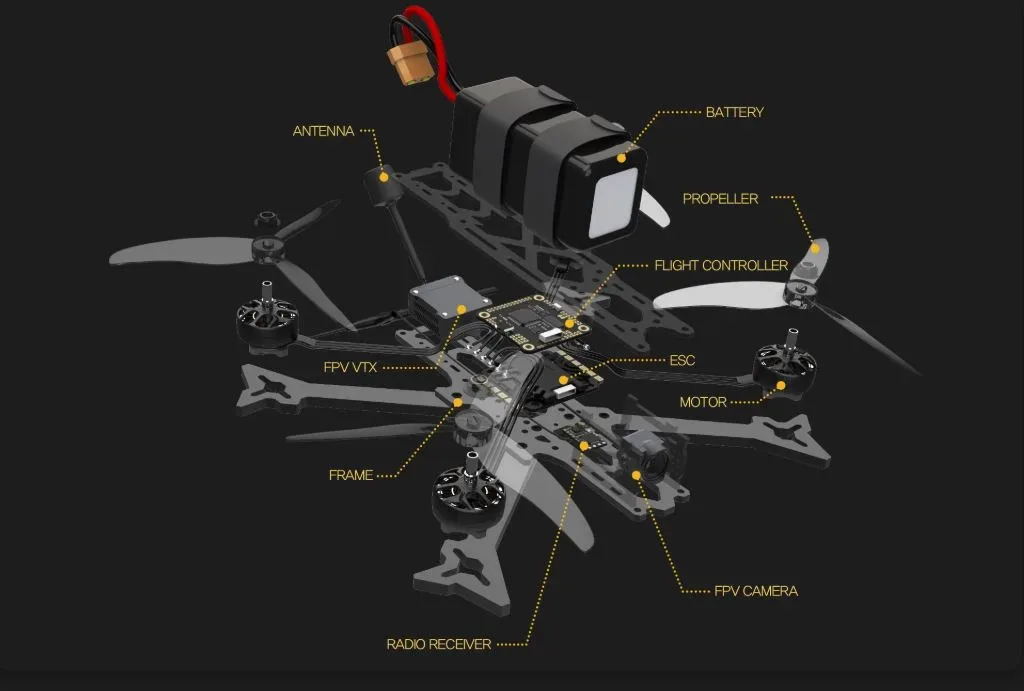
Search for how to get started with FPV drones and you're hit with a parts list first. Frame, flight controller, ESC, motors, propellers, receiver, battery. Then a camera, a video transmitter, and an antenna get added on top, plus you still need a controller and goggles. That's more than a dozen items.
Looking at that list, the obvious question is: why not just buy one ready-made?
For 5-inch FPV drones, there's essentially no such thing as an off-the-shelf model. There's a reason. Even within the same 5-inch class, the right motor, propeller, and battery all depend on what you're trying to do with the drone — and figuring out that combination is half the hobby. Building it is how you learn it.
That's why order matters. Buy your way down the list from the top, and you'll spend the most money possible.
Why the Controller Comes Before the Aircraft
The first thing to buy is a controller. Not an aircraft.
The cheapest, safest way to learn to fly is a simulator. You plug the controller into a computer and fly on screen. No crashes, no batteries burned, no weather to work around. But to run a simulator, you need a controller first.
What happens if you buy the aircraft first? You take your first flight without knowing how to fly, and you usually crash. Once it's crashed, figuring out what broke requires the very parts knowledge you didn't have yet. Buy the controller first, and you skip that loop entirely.
Sort Parts by What They Do, and the List Gets Shorter
The parts list feels long because it's not clear what each piece actually does. Group them by role, though, and there are only three: parts that fly the aircraft, parts that act as the pilot's eyes, and gear you hold in your hands.
The parts that fly the aircraft number seven. Everything else mounts to the frame. The flight controller acts as the brain, comparing your stick inputs against gyro readings and sending a different signal to each motor. The ESC converts the battery's DC power into three-phase AC to spin the motors. Each motor turns electricity into rotation, and the propeller turns that rotation into airflow. The receiver picks up the radio signal from the controller, and the battery powers the whole system.
The parts that act as the pilot's eyes number three. The FPV camera turns what's in front of the aircraft into a video signal, the video transmitter (VTX) broadcasts that signal, and the antenna is where that signal actually travels to and from. These three run on a path entirely separate from the flight system — if the video cuts out, the aircraft keeps flying; if the aircraft goes down, the video often keeps coming for a moment longer.
The gear you hold in your hands is the controller, the goggles, and the charger.
Split into these three branches, "what do I need to buy" becomes "which branch do I decide on first."
Whether Parts Actually Match Is a Matter of Math, Not Taste
The most common mistake when picking parts is choosing the best option in each category individually. Pick a great motor, a great ESC, and a great battery on their own, put them together, and you can end up with something that either burns out or won't fly — because they don't actually match each other.
Whether parts match isn't a matter of preference. It's math. There are four things to check.
Thrust-to-weight ratio is how many times its own weight the aircraft can push. Too low, and it'll get off the ground but won't respond the way you want.
Current chain checks whether the ESC, battery, and connectors can each handle the current the motors draw. It's called a chain because it breaks at the weakest link — even if the ESC has plenty of headroom, if the connector can't take it, that's where it burns.
KV is a motor's spin characteristic. Once you've settled on cell count and propeller diameter, there's a KV range that fits. A higher KV isn't better on its own — there's a KV that matches the rest of the build.
Takeoff weight ties directly to regulation. With a self-built aircraft, you have to calculate the weight yourself. Whether it crosses 250 grams or 2 kilograms changes what licensing and procedures you need — and that's decided at the parts-picking stage, before you've even built anything.
So Here's the Order
Before you write out a shopping list, there are things to decide first.
First, buy a controller and learn to fly on a simulator. You don't need an aircraft for this step.
Second, skim through what each part does. You don't need to memorize all of it up front — keep it as a reference to come back to when you need it.
Third, decide what you actually want to do. Filming, racing, or freestyle each call for a different combination, even within the same 5-inch class.
Fourth, verify the combination that fits your purpose against the four calculations above. By this point, you'll have an actual shopping list.
Fifth, that's when you buy the parts.
Making the list first and then buying is different from buying and making the list as you go. The latter usually means buying everything twice.
What to Do Next
If you haven't bought a controller yet, that's where to start. Several simulators are free to begin with, and a single controller can carry you through months of practice.
If you're already working through a parts combination, check takeoff weight first among the four calculations. Get the other three wrong, and you can just swap parts. Cross a weight threshold, though, and the entire regulatory procedure changes.