

AI Is Starting to 'Understand' the World

Until now, AI has been all about writing text well, generating great images, and producing solid code. You ask a question, it answers; you give an instruction, it generates. But the direction of AI research has recently begun to shift in a fundamental way. The goal is no longer to merely mimic patterns — it's to build AI that understands how the physical world works.

The key phrase driving this shift is the 'world model.' It's not yet a household concept, but in 2026 it has become the arena where the fiercest competition in the AI industry is playing out.

What Is a World Model?

Put simply, it means giving AI a 'simulator of the world' inside its head.

Large language models (LLMs) like ChatGPT and Claude learn from text to predict the next word that should come. Image-generation AI learns pixel patterns. Both are excellent at producing 'something similar to what they've seen before,' but neither understands the laws of physics. That a thrown ball traces an arc, that tilting a cup spills the water — these AIs don't actually 'know' it. They can describe it in words, but they can't actually simulate it.

A world model is different. It observes the current state and predicts what will happen next when a specific action is taken. The trajectory of a ball in flight, the physical interaction when a robot arm picks up an object, the dynamics of a car turning at an intersection — a world model is AI that can simulate these things internally.

It's a concept that Meta's chief AI scientist, Yann LeCun, has championed for years. He has consistently argued that today's LLM-centric approach faces fundamental limits on the road to physical intelligence. No matter how much text you train on, he says, you can never learn 'why' the world moves the way it does.

Why It Caught Fire Now

The world model isn't a new idea in itself. But there are a few reasons the competition suddenly heated up in 2026.

First, Big Tech started moving. Google DeepMind announced it would throw its full weight behind world-model research aimed at letting robots and autonomous systems understand physical environments and decide and act on their own. Nvidia is expanding a simulation ecosystem through its 'Omniverse' and 'Isaac' platforms, where factories and logistics sites can be trained and validated in virtual space. World Labs — founded by Stanford's Fei-Fei Li — has even released a commercial product built on a world model that can generate and edit three-dimensional space.

Second, the limits of AI agents have come into view. Over the past year, promises that AI agents would automate work poured in, but in the field they often stalled at the proof-of-concept (PoC) stage. There's a wide gap between AI that processes text well and AI that actually acts in the physical world. For a robot to pick up a part on a factory floor, what it needs isn't text comprehension — it's an understanding of the physical world.

Third, physical AI has emerged as the next battleground. Robotics companies like Figure AI and Boston Dynamics are applying AI-based perception and action models to boost what their robots can do, and the spread into manufacturing and logistics is beginning. As KAIST professor Jinwoo Shin put it, the perception is spreading that "the choices of the next five years will set the yardstick for physical-AI competitiveness over the next fifty."

Simulating the World on a Single GPU

Against this backdrop, one recent research result has drawn more attention than any other: LeWorldModel (LeWM), co-authored by Yann LeCun.

World-model research faced two big obstacles: training was unstable, and it demanded enormous computing resources.

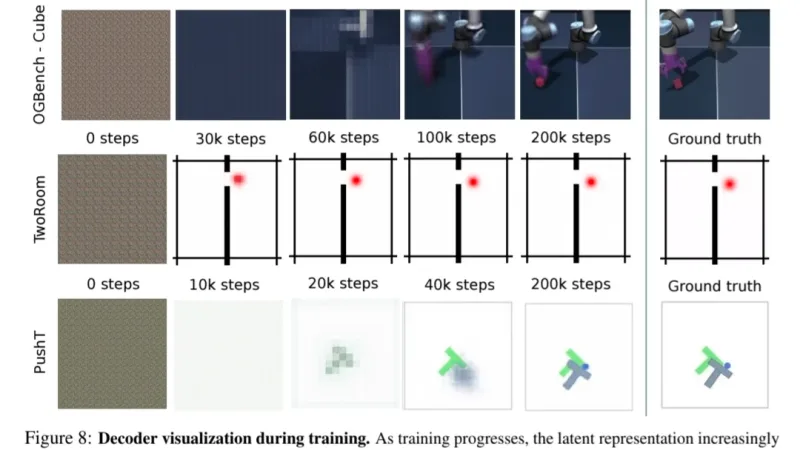
The JEPA (Joint Embedding Predictive Architecture) that LeCun proposed was theoretically elegant. It converts a scene captured by a camera (pixels) into a compressed representation, then predicts the next state within that representation space. The problem was that 'representation collapse' occurred during training — the model would map nearly all inputs to almost the same representation, so it effectively couldn't tell anything apart.

To prevent this, existing methods resorted to all sorts of workarounds. They combined six or more loss functions, bolted on a giant pre-trained encoder, or piled on complex tricks to stabilize training. The result was a heavy, unstable system you could really only run in a research lab.

LeWorldModel solved the problem with astonishing simplicity. It cut the loss functions down to just two: one to predict the next state, and one regularizer that forces the representation to follow a Gaussian distribution. This 'Gaussian regularization' method (SIGReg) is what prevents representation collapse. No elaborate workarounds — just a mathematically clean solution.

The results are striking. Fifteen million parameters. Compared with models like GPT-4 that use hundreds of billions of parameters, it's extraordinarily lightweight. Training finishes in a few hours on a single GPU. Planning is completed in under a second — 48 times faster than existing foundation-model-based world models.

On Push-T, a robotics benchmark, it posted a 96% success rate — a level competitive with models ten times its size.

Why This Matters

What LeWorldModel demonstrated isn't merely a technical achievement. It carries two implications.

First, the assumption that 'physical intelligence requires massive scale' is now shaking. The AI industry is currently racing toward trillion-parameter models. This is an era when Microsoft is pouring $80 billion into AI infrastructure and Google $90 billion. But if you can simulate the world with 15 million parameters, the scaling race isn't the only answer. A path has opened to solving the problem with a 'smarter architecture' instead of 'bigger.'

Second, startups and university labs can get into the game too. Research that needs thousands of GPUs is something only Big Tech can do. Research that needs just one GPU is something anyone can do. Naver Cloud executive Nakho Sung said at a National Assembly forum that "a world model further trained on real-world data will become a new growth engine for solving AI problems" — and it's only when lightweight models like this appear that those words actually become reality.

Where It Can Be Used

Once world models become practical, the range of fields they affect is broad.

Robotics. The most direct application. Robots can learn — virtually, before any real-world trial and error — how to grasp objects, avoid obstacles, and use tools in new environments. Figure AI and Boston Dynamics are already moving in this direction.

Autonomous driving. World models play a central role in simulating the complex situations that arise on the road. Extreme scenarios too dangerous to test on real roads — a pedestrian suddenly appearing, severe weather — can be recreated virtually, without limit.

Manufacturing and logistics. This is what Nvidia is already doing with its Omniverse platform. When changing a factory line's layout or optimizing a logistics route, you simulate it virtually before making the real change. The more sophisticated the world model, the higher the accuracy of the simulation.

Games and content. As World Labs has shown, world models are also used to generate and edit three-dimensional space in accordance with the laws of physics.

The Challenges That Remain

There are limits, of course. As the LeWorldModel researchers themselves acknowledged, performance actually drops in simple environments with low data diversity. The planning horizon is also still short. Accurately predicting far into the future remains a hard problem.

South Korea's situation isn't easy either. The National AI Strategy Committee has set a goal of becoming the world's number one in physical AI by 2030, but assessments keep pointing to a shortage of large-scale physical-data accumulation and long-term field-validation experience. At universities, competition over GPU access is fierce, and even after securing GPUs, electricity bills of several billion won a month are a burden.

But what research like LeWorldModel shows is that you don't necessarily need enormous infrastructure to compete. A single smart architecture can replace thousands of GPUs. This is no longer a game of scale — it's becoming a game of structure.

The era of AI handling text well has already arrived. Next comes the era of AI understanding the world. The world model is the core technology of that transition.