




"The customer doesn't even know what their own problem is."
The textbook sales formula that companies demand can be summed up in three words: 'Be diligent—be kind—be persistent.' Yet even those who possess all three in equal measure find it hard to become an ace—such is the nature of sales. There are people who run hard and still see their numbers frozen in place, and people who lie awake at night because a single word of rejection from a customer feels like a denial of their very existence. If you've been asking yourself, "Why doesn't it work, no matter how hard I try?", then it may be time to look back and ask whether you've been a 'diligent fool' all along.
An English literature student who had studied Shakespeare, the author began his working life as a salesman for household goods, and to overcome his own limitations he made diligence his weapon. He came in earlier and left later than everyone else, but for a 'diligent fool' who only ran hard without direction, the report card that came back without fail read: 'first in line to be let go.' Living through the moment when a store owner, enraged over a single tax-invoice error, hurled an envelope that grazed past barely a hand's width from his face, he learned in his bones that neither theory nor moving words carry any power in the field. The turning point that took the author from the edge of the cliff to becoming the nation's number-one sales champion was simple. After realizing that the essence of sales is not 'selling' but 'solving' the customer's problem, the author redesigned his own system from the ground up.
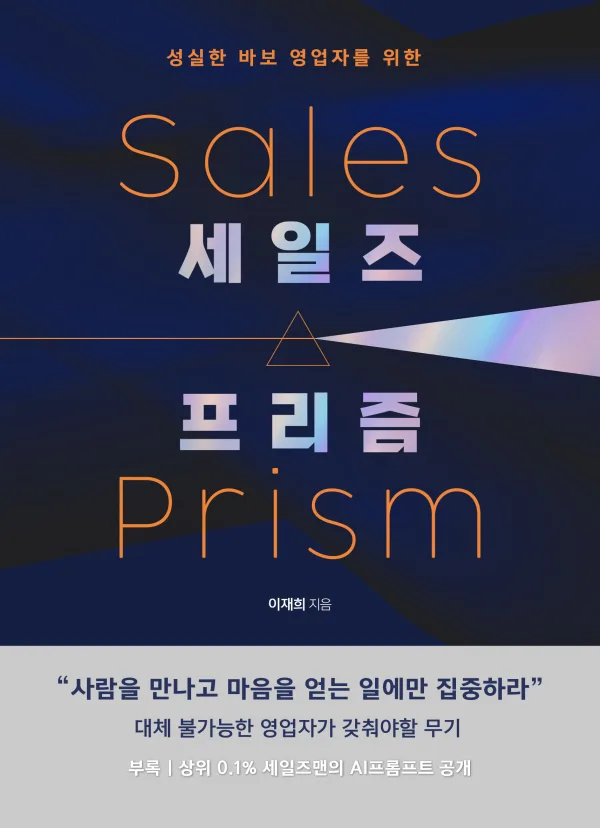
This book refracts that redesign process through five prisms: the Partner's perspective that spots the customer's problem first (P), the Resilience that converts rejection into data rather than emotion (R), the Information mastery that shrinks two hours of busywork into thirty minutes (I), the System that takes command of the density of time (S), and the Mastery that turns a niche into a golden egg (M). But these five are not laid out in the stiff format of a management textbook. By drawing the reader into the real on-the-ground stories the author actually faced, the book lets readers reflect on their own sales work and discover the lessons for themselves. If, while reading the stories, you find yourself wondering, "Which of the PRISM elements is this talking about?", you'll be able to picture concretely how to apply it to your own sales.
The appendix is the part you can put to use as your most immediate weapon. It contains, in their entirety, the sales prompts the author uses in actual practice. Give a sloppy command like "Write me a proposal" and the AI will serve up nothing but predictable answers. A true professional gives the AI different instructions from the very first command. Here is a way of using AI that shakes off the busywork nagging at you like a 'grain of sand in your shoe' and lets you be reborn as a true professional. To save two hours a day and spend that time solely on meeting people and winning their hearts—that is the real sales of the future that this book speaks of.
Even in the age of AI, some things will not change. It is a person who stands before the customer, a person's eyes that spot the problem, and a person's attitude that builds trust. PRISM—completed over twenty years of facing the field, from being first in line to be let go to becoming the nation's number-one sales champion. Are you ready to become the professional who spots the customer's problem first?