
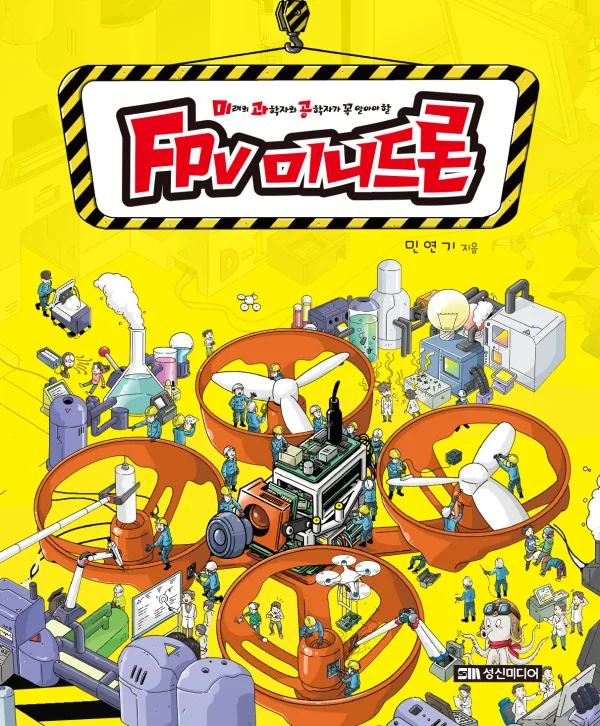



A collection of science and engineering technology that goes beyond a toy
Recently, drones have frequently been featured in various media for rescue, industrial, and entertainment purposes such as drone shows. As a result, they have grown more familiar to the public and interest in them has risen. RTF drones, so-called toy drones, are sold in the toy section of supermarkets.
However, 《FPV Mini Drone》 (미과공 FPV 미니드론) does not confine the category of drones to children's toys. A drone is a collection of physics and science technology. At this point, one might wonder, ‘Do I really need to know every single complex principle of an electrically powered “product”?’ But this book explains those complex scientific principles—propellers and the law of action and reaction, the relationship between magnetic force and the motor, the principles of the FC that serves as the drone's brain, and the relationship between the battery and voltage, current, and discharge rate—in a remarkably easy way, tailored to the level of children or beginners. In this way, 《FPV Mini Drone》 is the ideal introductory guide for anyone who has begun to take an interest in drones.
The thrill of slicing through the sky yourself: the FPV device
FPV stands for First Person View, meaning a ‘first-person perspective.’ An FPV device does not simply let you pilot a drone while watching it; it lets you fly through the sky through the drone's eyes. It is precisely the FPV device that allows a mini drone to be enjoyed not as a mere toy but as a serious scientific and engineering hobby. What's more, attaching an FPV device to a drone lets you do drone racing. An FPV mini drone is only smaller in size; it uses the very same parts, goggles, and controller as a real professional drone racer. The thrill of becoming a drone racer and roaming the sky yourself at astonishing speed—《FPV Mini Drone》 opens up not a world of toys, but the world of drone racers.
Engineering application of scientific principles: building an FPV mini drone
《FPV Mini Drone》 shows how to build your own distinctive drone using ice cream sticks as the frame. To start drone racing, assembling and repairing the drone and setting up the software are essential. If you understand the scientific principles of drones learned earlier, you gain the ability to select parts yourself and build your own higher-performing drone, rather than mechanically following the instruction manual enclosed with the parts.
The crowning touch of building a drone could be said to be the software setup. The book introduces the Betaflight software-setting program, which has recently been fully patched into Korean. Only when motor speed control and the delicate manipulation of the FC sensors achieve perfect harmony can you attain the optimal control that suits you. Once you complete your own distinctive FPV mini drone, you will feel a sense of pride along with a heightened interest in science and engineering.
Flying with the FPV mini drone
Now that the drone is complete, it's time to actually fly it. If you fly the drone hastily, there is a very high chance that the drone you worked so hard to build will be damaged. 《FPV Mini Drone》 presents the four basic drone-control movements—throttle, aileron, elevator, and rudder—along with various applied maneuvers, shown through 3D modeling illustrations so you can follow along enjoyably. By taking advantage of the mini drone's ability to fly indoors and practicing one movement at a time, before you know it you will feel how skilled your piloting has become.
Once you have learned everything about your mini drone with 《FPV Mini Drone》, why not try entering a drone race?