
“Who am I?”
The moment I peeled off the name tag I had worn for thirty years, my true story finally began.
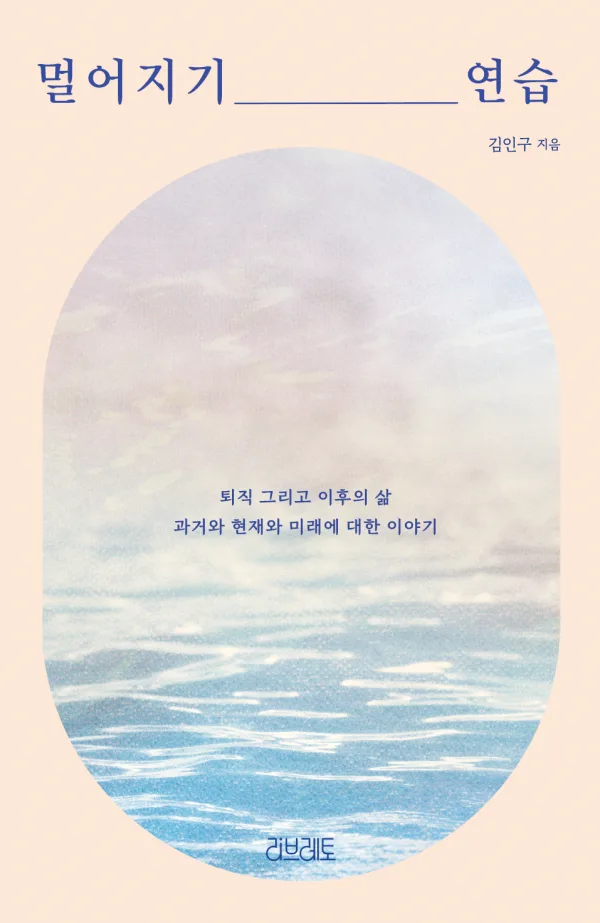
When we leave the company we spent thirty years with and have to live as ‘me’ rather than ‘the department head,’ what do we come face to face with? This book, The Practice of Drawing Apart (멀어지기 연습), is an essay in which the author—who spent thirty years at a large corporation—unfolds, calmly and candidly, the enormous life transition he goes through after retirement.
The author consciously begins ‘practicing drawing apart’ from everything he had striven all his life to ‘grow closer’ to—the company, his job title, the eyes of others. In the emptiness left when the place he went to every day disappeared, and the bewilderment of a life with no business card, he creates a new rhythm out of small daily things like cleaning, cooking, and early-morning Mass. Reflecting on a past in which he failed to stay by his family’s side, he forms a new bond with his wife through clumsy dishwashing, and through playing with his grandson he learns the wisdom of living in the ‘now.’
More than simply depicting life after retirement, this book warmly portrays how one man reclaims the self he had lost and—as a descendant of his clan’s head family who bridges past and future—is reborn as a ‘public historian’ and a ‘calli-designer.’ For everyone wrestling with which way to turn at a crossroads in life, it will be a kind, gentle guide showing that ‘drawing apart’ is not severance but the start of a deeper connection.
Self-Development


The Practice of Drawing Apart
Retirement, and the Life That Follows
“Who am I?” The moment I peeled off the name tag I had worn for thirty years, my true story finally began. When we leave the company we spent thirty years with and have to live as ‘me’ rather than ‘the department head,’ what do we come face to face with? This book, The Practice of Drawing Apart (멀어…

Prologue: We Only Learned How to Grow Closer
Part 1: Taking Off the Name Tag
01. Retirement
02. The Place I Went Every Day Was Gone
03. A Life Without a Business Card
04. Don’t Try So Hard to Do Everything Well
05. It Seems My Wounds Are Starting to Heal
06. The More Urgent, the Slower
Part 2: Creating a New Rhythm
07. My Cleaning Time
08. Early-Morning Mass
09. A New Habit: Asking and Answering
10. I Find It Hard to Speak Casually
11. A Bittersweet Companionship
12. I Hope I Can Become Someone Like That
Part 3: The Closest Person
13. Back Then, in That Moment, I Wasn’t There
14. You Just Have to Listen
15. Only Now Have I Put On an Apron
16. The Man from Mars, the Woman from Venus
17. Distinction Between Husband and Wife
18. To My Wife (A Letter Sent in Advance)
Part 4: A Heart That Connects Generations
19. Father, Mother, I Miss You
20. Please Take Good Care of Our Youngest
21. A Friend Beyond Generations
22. The Wisdom of Letting Go of Myself
23. The Legacy of Everyday Life
24. ChatGPT and Dongmongseonseup
25. We Need a ‘Kkondae’
26. Passing Down Taste
Part 5: Preparing for Life’s Finitude
27. My Father’s Class Reunion
28. A Brief Encounter, a Long Reflection
29. Reading Hearts, Leaving a Heart Behind
30. Japyo: Writing My Own Epitaph
31. What Grows Closer Only by Drawing Apart
32. Mission: In Search of the Essence I Had Forgotten
Part 6: The Work of Connecting Past and Future
33. Conversing with Forgotten History
34. I Am a Public Historian
35. The Story of the Mong-o Head Family
36. Gyeminga: A Ninety-Line Letter to the People
37. Reexamining Joseon and the Scholar-Officials
38. A New Language to Untangle the Knotted Threads of History
39. Calli-Design Brought Out of the Museum
40. The Head Family’s Calli-Design Steps Onto the World Stage
41. Writing a New Business Card
Epilogue: From Question Mark to Comma
Kim In-gu
As the eighth-generation head-family heir of Mong-o Kim Jong-su—a distinguished statesman during the reign of King Jeongjo of the Joseon dynasty—the author has carried on the 600-year history of the Cheongpung Kim head family. Building on the rich financial experience he accumulated at Samsung C&T, Samsung JP Morgan, Samsung Securities, and KB Securities, he is forging a second life as an artist after his retirement.
In the academic sphere, he has worked as a researcher at the Institute of East Asian Classical Chinese Literature at Sungkyunkwan University, and through a visit to the Chữ Nôm Research Institute in Vietnam he opened new horizons in the study of East Asian script culture.
He has contributed to the public use of cultural heritage by depositing and donating the head family’s precious old books and artifacts to the Jangseogak Archives of the Academy of Korean Studies, the Seoul Museum of History, and the Seoul Life History Museum, and he has brought about the preservation and contemporary succession of traditional culture by leading related exhibitions and academic conferences at the National Museum of Korea, the Kyujanggak Institute at Seoul National University, the Suwon Hwaseong Museum, and elsewhere.
In particular, the author’s calli-design goes beyond mere artistic activity; by reinterpreting the head family’s history and documentary culture in a contemporary way, it opens up new possibilities for the field of public history. He also plays an important role in widely sharing the contemporary value and meaning of traditional culture through his work with Korean Scholar-Official Leadership and the Dolol Center.