




Business & Economics

Cafe Branding

The First Step in Preparing to Open a Cafe

Author 배주태

Publisher 리브레토

Published Oct 16, 2024

Pages 314 pages

Size 145×200mm

ISBN 9791190917162

Price 18,500 KRW

Many people start their own independent cafe with great enthusiasm, but most end in failure. The reason is that they jump in blindly, without clearly defining their cafe's identity and without any 'branding.' Branding does not simply mean a logo or a pretty interior. 'Branding' is the entire process…

Cafe Branding Detail images

The power that makes an independent cafe special and beloved by customers: 'branding'

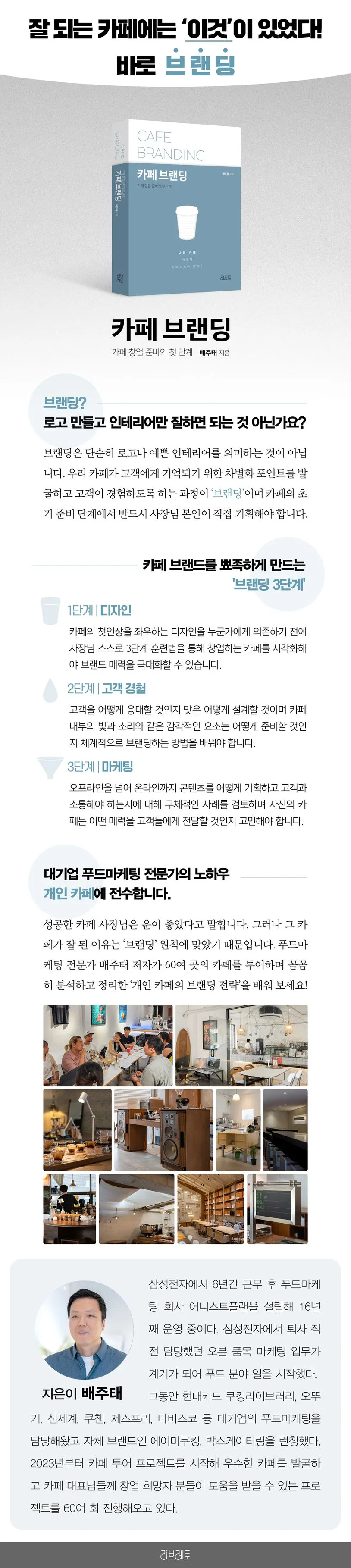
Many people start their own independent cafe with great enthusiasm. But the reality is that most end in failure. Why is that? It is because, without clearly defining their cafe's identity, they started blindly, with no 'branding.'

Branding does not simply mean a logo or a pretty interior. The entire process of discovering the differentiating points that make our cafe memorable to customers and letting customers experience them is precisely 'branding.' Every successful cafe has its own clear brand identity, and through it, it settles deeply into customers' hearts.

Cafe Branding (카페 브랜딩) presents practical methods for an independent cafe to build successful branding through three core elements: design, customer experience, and marketing.

Design: The Power of Space That Determines First Impressions

Design, which determines a cafe's first impression, is something the owner must develop an eye for personally, rather than leaving it to an interior firm. If you hand it over to others, the cafe's unique identity tends to disappear and the space easily becomes generic. This book introduces a three-stage training method for sharpening your eye for design and guides you step by step through concrete ways to reflect your spatial identity in the interior.

Customer Experience: A Holistic Experience Beyond a Single Cup of Coffee

The experience at a cafe is not simply the taste of the coffee, but the emotions and memories the customer feels throughout the entire process of using the cafe. From the moment they open the door and step inside to the moment they finish paying and leave, every touchpoint becomes an opportunity for branding. This book explains a detailed methodology for completing cafe branding through three core elements: taste, the customer journey, and light and sound.

Marketing: Brand Communication Beyond Sales Promotion

Marketing is not merely a sales promotion activity. It should aim to fully reflect your branding and turn your cafe into one that customers want to visit again. True marketing is not relying solely on one-off events or discounts, but continuously delivering and reinforcing the cafe's brand value. This book presents a balanced approach to online and offline marketing strategies and introduces the pros and cons and applications of each alongside real-world case studies.

This book goes beyond the textbook talk of mere cafe startup and operation know-how, containing the core methodology of branding that sharply delivers a clear message to customers. If cafe owners establish their own identity through branding, they will be able to lay a solid foundation for steady, unshakable growth even when a competing cafe opens right next door.

Through Cafe Branding, take the first step toward growing your cafe beyond a mere coffee shop into a brand that holds special meaning for your customers.

PROLOGUE
   
   01 - Start Your Cafe Branding

▪ The Definition of Cafe Branding

- Brand, Branding, and Marketing

- Independent Cafes Need Branding Too

- The Most Important First Question: 'Me'

- Generating Ideas and Organizing Your Thoughts

▪ Designing My Cafe Brand

- The Three Principles of Brand Design

- Planning a Cafe Brand with the Q-CARD

- Visualizing Your Branding: The Mood Board

- Define Your Brand in Words


02 - The First Element of Cafe Branding: Design

▪ An Eye for Design

- The Basis of Design Is Consistency

- A Three-Stage Training Method for Sharpening Your Eye for Design

▪ Cafe Design

- Interiors That Reflect Spatial Identity

- Two Interior Construction Methods: Semi-Self and Turnkey

- Design Beyond the Interior

※ Practical Tools & Services for Design


03 - The Second Element of Cafe Branding: Customer Experience

▪ The First Customer Experience: Taste

- Setting Your Taste-Quality Goal

- The Three Elements of New Menu Development

※ Dessert Recipe Class

▪ The Second Customer Experience: The Customer Journey

- Designing and Analyzing the Customer Journey

- The Core of the Customer Journey: Customer Service

- Three Tips for Successful Communication

▪ The Third Customer Experience: Light and Sound

- Light and Sound to Apply to Your Cafe Interior

- How to Design Light

- How to Produce Sound


04 - The Third Element of Cafe Branding: Marketing

▪ Four Basic Aspects of Understanding Marketing

- Marketing That Reflects Your Branding

- Essential Marketing Materials

- Pleasant Customer Participation

- Online Marketing vs. Offline Marketing

▪ Online Marketing in Depth

- Strategies for Designing Instagram Marketing

- Six Points for Planning Content to Drive Traffic

※ Make Active Use of Instagram Freelancers

▪ Offline Marketing in Depth

- Offline Marketing Strategies

- Six Cases of Offline Marketing That Drive Repeat Visits

   Appendix - Case Studies

EPILOGUE

Bae Ju-tae

After working at Samsung Electronics for six years, he founded the food marketing company Earnest Plan, which he has been running for 16 years, as a management consultant and business manager. The oven-category marketing work he handled during his time at Samsung Electronics became the catalyst for him to become an expert in the food field.

Over the years, he has built rich hands-on experience handling food marketing for a wide range of companies, including Hyundai Card Cooking Library, Ottogi, Shinsegae, Cuchen, Zespri, and Tabasco. He has also proven his capabilities as an entrepreneur by successfully launching his own brands, Amy Cooking and Box Catering.

Since 2023, he has launched a cafe tour project, discovering outstanding cafes and carrying out meaningful work that connects cafe owners with aspiring founders. He has run such projects more than 60 times to date, contributing to the development of the food-and-beverage startup ecosystem.