
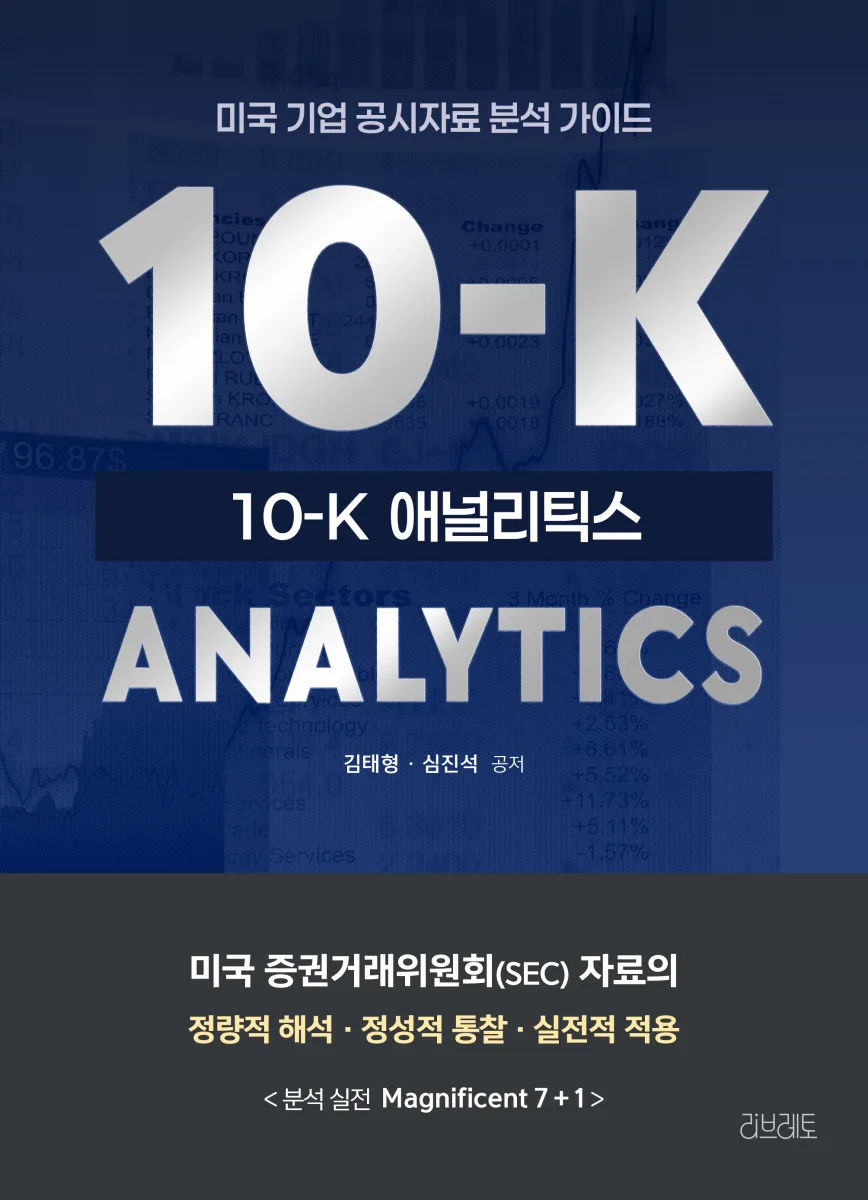
As of January 2026, the total value of U.S. stocks held by Korean investors had surpassed roughly 250 trillion won. Yet only a tiny fraction of those investors have ever read Form 10-K, the annual report that companies file directly with the U.S. Securities and Exchange Commission (SEC) under legal liability. This book (10-K 애널리틱스) is a hands-on guide for independent investors who read and interpret the original SEC filings for themselves.
Part 1 covers the structure of the SEC disclosure system, how to search the EDGAR system, item-by-item analysis of the 23 items in Form 10-K, and an in-depth analysis of the MD&A. Part 2 builds your foundational investment stamina through reading financial statements, industry analysis, the six key financial ratios, and analytical frameworks tailored to different investment philosophies. Part 3 directly analyzes the actual Form 10-K filings of eight companies, including Microsoft, Apple, Alphabet, Amazon, Nvidia, Meta, Tesla, and Coupang.
The authors are transfer pricing specialists in the Tax Group at Yulchon LLC. Drawing on their expertise in analyzing the business structures and financial flows of global companies, they offer a distinctive perspective that interprets Form 10-K as a record encapsulating management's strategy and perception of risk.
Business & Economics



10-K Analytics
A Guide to Analyzing U.S. Corporate Filings
An essential investing guidebook for anyone who makes investment decisions based only on news headlines, ten-minute YouTube summaries, and emotionally charged community posts. The U.S. stock market is the most transparent market in the world. Train your eye to analyze Form 10-K, the annual report th…

Prologue
Before You Begin
About the Authors
EDGAR Quick Links
Part 1_ Reading U.S. Stock Information
Chapter 1. Understanding the U.S. Disclosure System
01. The Structure of the SEC Disclosure System
02. The SEC's Disclosure Philosophy and Investor Protection
03. Understanding the Three-Dimensional Matrix of the SEC Disclosure System
04. Filing Deadlines and Legal Liability for Disclosure Reports
Chapter 2. Mastering the EDGAR System
01. EDGAR Architecture and Using Each Document Format
02. A Step-by-Step EDGAR Search Practice Guide
03. The Importance of Using Interactive Data and XBRL
Chapter 3. A Complete Analysis of the Form 10-K Structure
01. Dissecting Form 10-K in Detail
02. Analyzing Structural Connections and Cross-References Among Items
03. Understanding Regulation S-K and S-X
Chapter 4. In-Depth Analysis of the MD&A
01. Analyzing the Four Key Components of the MD&A
02. Analyzing Textual Tone and Tracking Keyword Changes
03. Interpreting Forward-Looking Statements
Part 2_ Building Investment Stamina
Chapter 5. Understanding Companies and Capital Markets
01. What Is a Company?
02. Reading Financial Statements, 'the Language of Business'
03. How Companies Raise Capital: Debt and Equity
04. What It Means to Own Stock
05. Distinguishing Among Stock Markets
06. How the Stock Market Works
Chapter 6. An Eye for Interpreting Industries
01. The Definition of an Industry and Its Role in the Economy
02. Major Industry Classification Systems and Their Characteristics
03. The Correlation Between the Macroeconomy and Industries
04. Industry Profitability Structures, Competitive Dynamics, and Financial Structures by Industry
05. Definitions and Characteristics of Major Industries
Chapter 7. Reading Corporate Performance Through Numbers
01. Profitability Ratios
02. Liquidity Ratios
03. Efficiency Ratios
04. Leverage Ratios
05. Market Ratios
06. Cash Flow Ratios
Chapter 8. Analytical Frameworks That Vary by Investment Philosophy
01. Analyzing Form 10-K from a Value Investing Perspective
02. Analyzing Form 10-K from a Growth Investing Perspective
03. Analyzing Form 10-K from a Dividend Investing Perspective
Part 3_ Hands-On Analysis
1. Microsoft: A Textbook Case of Cloud Transformation
2. Apple: The Essence of the Ecosystem Business
3. Alphabet: From Advertising to AI
4. Amazon: The Synergy of E-Commerce and Cloud
5. Nvidia: The Infrastructure of the AI Era
6. Meta: Balancing the Metaverse and Efficiency
7. Tesla: An Energy Company Beyond Automobiles
8. Coupang: K-E-Commerce's Global Challenge
Epilogue
Kim Tae-hyung
- · Currently with the Tax Group, Yulchon LLC
- · Formerly with the Tax Division of KPMG Samjong Accounting Corp. and the Tax Group at Yoon & Yang LLC
- · U.S. Attorney (DC), U.S. CPA (ME), U.S. Enrolled Agent, U.S. Certified Management Accountant (CMA)
- · Bachelor's in Finance, University of Illinois (U.S.); Master's in U.S. Law, University of Connecticut
He currently works in the Tax Group at Yulchon LLC. Previously, he worked in the Tax Division of KPMG Samjong Accounting Corp. and the Tax Group at Yoon & Yang LLC, providing international tax and transfer pricing advisory services to multinational companies. He holds qualifications as a U.S. Attorney (Washington, D.C.), a U.S. Certified Public Accountant (Maine), a U.S. Enrolled Agent (EA), and a U.S. Certified Management Accountant (CMA), and has analyzed the global business structures and financial flows of companies on the basis of integrated expertise spanning law, accounting, and tax. He majored in finance at the University of Illinois and earned master's degrees in law from Korea University, Hallym University of Graduate Studies, and the University of Connecticut.
He views numbers not as mere results but as traces of corporate decision-making. His strength lies in analysis that reads the strategy and judgment of management embedded in financial statements and disclosure materials, and he is drawn to the work of structurally interpreting why a company made the choices it did. This perspective carries through to the book's core analytical viewpoint—reading a company's business structure and strategy, along with management's decisions, through the vast disclosure document that is Form 10-K.
Shim Jin-seok
- · Currently with the Tax Group, Yulchon LLC
- · Formerly with the Tax Division of EY Hanyoung and the Deal Division of KPMG Samjong Accounting Corp.
- · U.S. Certified Management Accountant (CMA)
- · Bachelor's and Master's in Sociology, Peking University, China
He currently works in the Tax Group at Yulchon LLC. Previously, he worked in the Tax Division of EY Hanyoung and the Deal Division of KPMG Samjong Accounting Corp., where he carried out tax advisory, corporate valuation, and transaction-related financial analysis work. He holds a qualification as a U.S. Certified Management Accountant (CMA), and his strength lies in combining financial data with management information to analyze companies' business structures and revenue models. He completed his bachelor's and master's studies in sociology at Peking University in China, through which he developed an analytical perspective that views companies not only through numbers but also from the standpoint of organizational and industry structure.
Through providing tax and financial advisory services to a wide range of companies at advisory firms, he has closely analyzed how companies design their business structures and generate revenue. Building on this experience, he understands corporate disclosures not as a mere list of information but as a set of strategic messages that a company conveys to the market and to investors. His approach—reading the numbers and sentences in a Form 10-K together to interpret a company's actual business structure, competitiveness, and the context of management's decisions—becomes an important analytical axis running through the entire book.